








Music
Subject Introduction
Overview and Rationale
This plan is for the information of all teachers and staff, visiting tutors, Bolton Music Hub, and other relevant members of the school community.
Rationale
At Thornleigh Salesian College, we believe that the music curriculum should provide pupils with the opportunities to engage with a range of musical styles, through listening and appraising, composing, and performing. We strive for them to become involved in movement and drama through music.
|
“A school without Music is like a body without a soul.” Don Bosco This plan has been devised in response to the governments document. ‘The Power of Music to Change Lives’ - ‘A National Plan for Music’ – June 2022. |
This plan has been devised in order to:
- Benefit the teaching and learning of music in our school.
- Provide a coherent approach to the teaching of music across the department.
- Review the existing plan for music considering the new Model Music Curriculum
- Create a core curriculum for all aspects of music for all class levels.
- To support and develop extracurricular opportunities for our students.
- To give access to instrumental/vocal lessons
|
Detail |
Information |
|
Academic year that this summary covers |
2025 - 2026 |
|
Date this summary was published |
July 2025 |
|
Date this summary will be reviewed |
July 2026 |
|
Name of the school music lead |
Miss H Birtley |
|
Name of school leadership team member with responsibility for music (if different) |
Mrs C Harrison-Scott |
|
Name of local music hub |
Bolton Music Hub |
Part A: Curriculum Music
Vision
Our vision is to cultivate a vibrant and inclusive music department where students are inspired to explore their creativity, develop their talents, and communicate through the universal language of music. We aim to create an environment that nurtures artistic expression, fosters a deep appreciation for diverse musical traditions, and equips students with the skills to excel both academically and personally through the power of music.
Aims
We endorse the aims of the Model Music Curriculum and NPME to:
- At Key Stage 3, curriculum Music is taught within a two-week timetable that includes one 95 -100 minutes Music lesson for every student.
- Access to lessons across a range of instruments, and voice.
- A school choir and/or vocal ensemble.
- School ensembles/bands/groups.
- Space for rehearsals and individual practice.
- A termly school performance.
- Opportunity to enjoy live performance e.g. Student performances in Chapel assembly every week.
BBC Philharmonic rehearsals, Bury College Samba
- Enable the child to develop his/her musical potential and to experience the excitement and satisfaction of being actively engaged in musical creativity.
- Nurture the child’s self-esteem and self-confidence through participation in musical performance.
- Foster higher-order thinking-skills and lifelong learning through the acquisition of musical knowledge, skills, concepts, and values
- Enhance the quality of the child’s life through aesthetic musical experience.
- Foster a sense of community by singing together and performing.
- Provide pupils with an opportunity to perform using their musical talents e.g. Concerts, Carol Services, Rock, Pop and Musical Theatre Nights, Community events, Assemblies.
Curriculum Planning
Model Music Curriculum / Sequencing
All teachers are familiar with the sequencing of units and how they fit within the new content objectives of the model music curriculum.
Teachers are encouraged to teach music using alternative methodologies and resources that match their own musical abilities and strengths. They are expected to adapt their individual plans to cover the INTENT and ensure all students in the class are supported.
Collaborative planning along with informal and formal meetings between class teachers are utilised to assist in planning.
Teachers are familiar with the interrelated dimensions of music - a sense of pulse, duration, tempo, pitch, dynamics, structure, timbre, texture, style - to be taught.
All three strands – Listening, Performing and Composing, should be comprehensively covered but emphasis will be given to performing and given the current climate of Music, a strong focus on Music Technology.
All children at KS3 are actively engaged in music education at Thornleigh.
Students are given the opportunity to engage with instrumental and vocal lessons with a member of staff, where they learn to read music and develop skills on their chosen instrument.
Opportunities are provided to enhance children’s lives through music by performing in and attending concerts (one per term), School Shows and other school events.
Listening
Students are provided with opportunities to listen and respond to music during their lessons. Teachers ensure that students experience a wide range of musical styles, traditions, and cultures as evident in the selection of pieces for the core curriculum. We use the Mad T-shirt model to develop student understanding of the key components and strands of Music.
The teacher provides opportunities for active listening and responding e.g. through questioning, prompting, suggesting, listening to short examples repeatedly and responding in some of the following ways:
- Talking about …
- Listening for specific instruments and/or specific features
- Writing in response to music or Composing
- Singing or playing along with music
- Musical games and/or action songs
Students are provided with opportunities to work in different groupings, e.g. whole group, small groups, pairs, individually.
Students are provided with opportunities to work collaboratively/cooperatively.
Students are provided with opportunities to offer varying and creative solutions to presented problems.
A broad range of materials is provided for listening and responding e.g.
- Recorded music on video or music technology.
- Tuned and untuned percussion instruments.
- Melodic instruments such as piano, ukulele, guitar.
- Performance of a group, ensemble, band, choir, orchestra visiting the school or at another venue.
- Recorded music is selected from a wide range of sources, all listed on the Model Music Curriculum e.g. film/orchestral music, music from other countries, popular conventions, choral and instrumental and music for different/special occasions.
Performing
In performance, the following are emphasised:
- Active enjoyable participation
- Development of skills, understanding, knowledge and technique.
- Fostering of students attitudes and interests
- Development of creativity.
Approaches to music literacy include the use of whiteboards, scaffolded listening, Mad T-shirt and tab and traditional notation systems.
Students are provided with opportunities to play a variety of instruments at appropriate times in class. These sessions are structured so that students have a key focus of embedding skills, not just playing. All of our keyboards/pianos have pedals to foster accompaniment skills at the keyboard. We also have a lending library of keyboards to lend to students.
Composing
Students are encouraged to compose music through:
- Composing melodies at the piano and exploring melodic structures and forms.
- Composing for a purpose (programme/film music)
- Composing pieces that are written down in traditional notations using music software.
- Composing by using a variety of different technologies e.g. Studio One, CFubase, BandLab, Sibelius and Musescore.
We recognise that there is a natural linkage across the strands of the music curriculum e.g. while pupils are engaged in performing and composing lessons, they will also be listening and responding.
Assessment and Record Keeping
Assessment plays a crucial role in the teaching and learning of music by identifying the skills pupils already possess and highlighting areas that need revisiting, mastery, or advancement. It evaluates students’ overall musical ability, interest, and participation levels, as well as individual aspects of each musical strand.
Teacher observation and verbal feedback serve as the primary assessment tools, ensuring a comprehensive and dynamic approach to student development in music.
Other assessment tools used are.
- Teacher-designed tasks
- Recordings of the students’ work (often submitted online via Studio One)
- Performance at a particular school event e.g. Christmas Concert Rock, Pop and Musical Theatre Night.
Assessment is recorded in teachers’ notes and in rubrics on Google Classroom and in Sims.
This is communicated to parents throughout the year.
Student practical progress is measured over a series of lessons, not a final assessment. This is a holistic view of their skills rather than a summative judgement on one 30 second performance. Constant effective, timely and accurate verbal feedback is key to the development of pupils in Music. This is a constant and ongoing feature of all lessons.
SEND
At Thornleigh Salesian College all students participate in music within the classroom. Teachers will, if required, vary the pace, content, and methodologies to ensure learning and success for all students. Every effort will be made to simplify the language and technology for students with SEND. Equally, where a teacher recognises a musical talent within a student, this will be nurtured as far as possible, and the teacher will communicate this with the parents/guardians so that they may nurture the talent e.g. before school rehearsals or in Extra Curricular groups at lunchtime or after school.
Equality of Participation and Access
Equal opportunities are given to all students regardless of gender, ethnic background or socio-economic status across all strands and activities. Music class may be used as a means of integrating different cultural backgrounds, which may exist in the class at the time.
Timetable and KS3 Frequency
Time is allocated on a two-week timetable with classes at KS3 receiving a 95-100-minute lesson once a fortnight. This is something we value highly in the department. 100-minute lessons give fantastic opportunities to not only embed the foundations of the lesson, but also give adequate time for students to work on key knowledge, concepts, and mastering skills.
Health and Safety
Teachers are constantly aware of health and safety when conducting lessons. When planning, and during Music lessons, consideration will be given to the following:
- Hidden dangers when students are moving around the classroom.
- Storage facilities
- Access to, and transport of, equipment and instruments
- Ventilation of the classrooms
- Amount of space for students to sit/stand when doing choral or instrumental work.
- Appropriate volume levels when using audio equipment and instruments.
Individual Teacher’s Planning and Reporting
This whole school plan, core curriculum and the curriculum documents for music, provide information and guidance to individual teachers for both their long- and short-term planning.
These will be reviewed in collaboration with the department during weekly collaborative planning sessions.
Staff Development
- Teachers have access to reference books, resource materials, instruments, equipment, and websites dealing with music.
- Miss Birtley is an assistant examiner for the OCR GCSE Music Listening and Appraising paper.
- Staff are consulted about the purchasing of instruments and materials for music.
- Information about in-service courses, school visits, musical events are communicated to all.
- We are always looking at opportunities for staff with expertise in the areas of music to share their ideas with other staff members e.g. co-operative teaching.
- Time is allocated at staff meetings (collaborative planning) to discuss aspects of the music curriculum.
- Links have been made with Bolton Music Service Hub for bespoke CPD sessions.
- Subject Leader attends network meetings when available.
Part B: Co-curricular music
Enrichment
The Music department has a rich history of running extra-curricular clubs, this is on the rise once more following the setback which was Covid-19. Below is the current timetable of events which will be developed further into 2024-25.
|
Monday |
Tuesday |
Wednesday |
Thursday |
Friday |
|
Lunchtime GCSE Sessions
After School Rock Bands Practice KS3 and KS4/5
School Production |
Lunchtime GCSE Sessions
After School GCSE Session
School Production |
AM Year 7 and 8 Rehearsal, Practice Time and Bands
String Group Lunchtime GCSE Sessions
Mixed Ensemble twice every half term |
AM Year 8 and 9 Rehearsal, Practice Time and Bands Lunchtime Choir GCSE Sessions After School – Rock Band Practice
School Production |
Lunchtime GCSE Sessions
Lunchtime Drum Session
|
Instrumental Lessons and Visiting Tutors
We have seven visiting tutors from Bolton Music service:
|
Monday |
Tuesday |
Wednesday |
Thursday |
Friday |
|
Piano Mr Barnes 9-12.30 |
Guitar Mr Barnes 9-3.30
|
Strings Mrs Hoyle 9-12.30
Brass Mrs Somers 9-12.30
|
Vocal Miss Hamblyn 9.00 - 3.10
Woodwind Mrs Kay 9.30 - 10.30 |
Drum Kit Mr Yates 9.00 - 3.10
|
10% of students access instrumental/vocal lessons. A document is available that highlights participation across Years 7-13 and the % of students per year group, gender breakdown and PP and LAC students.
Community Links
The staff at Thornleigh are very open and encouraging to any member of the local community who wishes to share their musical talent/skill with the students and will facilitate this where possible. Community members are invited to attend school events, especially the pensioners’ Christmas party. Performances in music are uploaded on the school website and YouTube channel, for parents/guardians and community members to view. We hold a primary carol service every December with many catholic primaries from across Bolton attending, our Carol service and school productions and Rock, Pop and Musical Theatre Nights. Many of our school bands audition every year for the BMS ‘Battle of the Bands’. These opportunities acts as an inspirational tool to both students at Thornleigh and our feeder Primary Schools, as well as their parents and the local community.
Bolton Music Hub
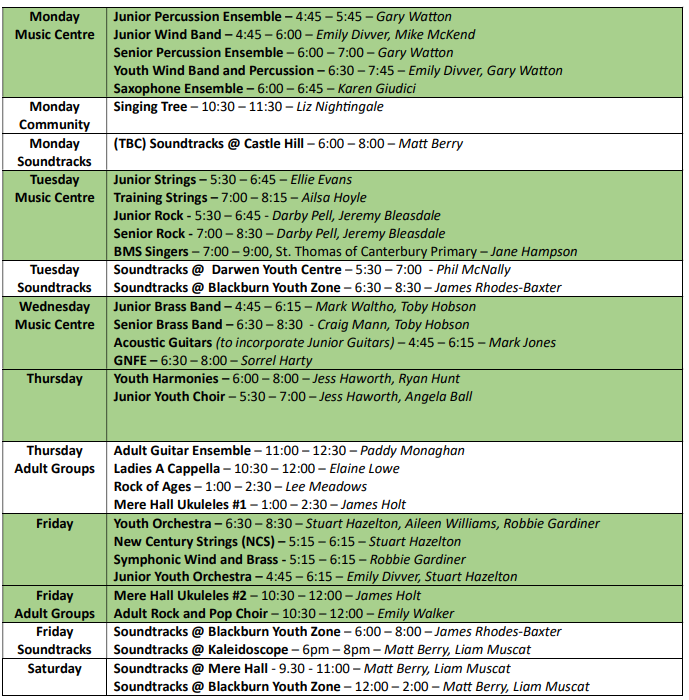
We have strong links with the Bolton Music Service and many of our young musicians attend the evening ensembles held at Mere Hall. These are open to all students and a timetable can be found below of when the different activities take place.
Part C: Musical Experiences
Performance Opportunities
There are many performance opportunities throughout the school year.
Students perform in chapel assemblies on a weekly basis giving all our students an opportunity to hear live performances every week but also opportunities for our young musicians to perform to a live audience.
Rock, Pop and Musical Theatre Nights– These are held in November and in April.
School Production - Held in December
Carol Service - All school ensembles perform after the CarolService in the main hall and anyone who wants to perform a solo may perform also.
Rock, Pop and Musical Theatre Nights– The second of these events takes place at the ned of the Spring Term.
Performing Arts Showcase - Students present their performance and compositions to an invited audience.
GCSE Showcase - Students present their performance and compositions to an invited audience.
Summer Concert – This is an opportunity for all students who have instrumental or vocal lessons to perform. All school ensembles perform and anyone who wants to perform a solo may perform also.
We also run a Savio Music weekend for all students. These usually take place in January each year.
Students have opportunities to attend shows and concerts in Manchester and our GCSE students recently attended a live BBC Radio 3 concert at the BBC Philharmonic celebrating ten years of the BBC Ten Pieces.
Part D: In The Future
The Music department has always had high expectations of all pupils and their musical goals. We aim to continue to inspire the students at Thornleigh Salesian College and celebrate Don Bosco’s statement.
Below is our key focus for the department for the future.
- To increase participation in instrumental and vocal lessons further and increase our provision further for our disadvantaged students.
- To develop further our singing opportunities within the curriculum.
- To increase our provision for students to practice in school.
Impact
The success of this whole school plan will be monitored and assessed; we will know if the plans have enhanced pupil learning if:
Students have:
- a positive attitude and appreciation of music.
an interest in expression through music. - engaged in listening and responding, performing, and composing music.
- have listened and responded to music from a wide variety of genres and cultures in a variety of ways.
- sing songs appropriate to their vocal range from a wide variety of genres and cultures.
- playing a variety of instruments with technique and skill.
- experienced a variety of ways of recording music.
- are able to improvise and create music using a variety of sound sources.
- able to talk about, evaluate, and record their work.