




Religious Education
Subject Introduction
"The future of humanity lies in the hands of those who are strong enough to provide coming generations with reasons for living and hoping"
Gaudium et Spes
“It is not enough for you to love them; they must know that they are loved”
(St. John Bosco)
The Religious Education Department is dedicated to fostering the spiritual, moral, and personal development of all students, ensuring they leave with a deep understanding of the Catholic faith and the Salesian ethos, in line with the school's core values. By the end of their course of study, students will have developed a profound sense of responsibility, both to their own faith and to the wider community, underpinned by a commitment to the principles of justice, peace, and respect for all. Our curriculum provides students with the opportunity to explore and reflect on core religious teachings, including the study of world religions, moral values, prayer, and worship, while encouraging critical thinking and personal reflection on the "ultimate questions" of life.
We aim for students to grow in their faith and personal integrity, to have a strong sense of self-worth, and to develop a clear understanding of their role in society as both “good Christians and honest citizens,” as articulated by St. John Bosco. By the end of their studies, students will not only have an informed understanding of religious concepts, but also the skills to communicate, collaborate, and reflect effectively on their beliefs, values, and experiences. Moreover, students will develop an open-mindedness towards diverse cultures and worldviews, alongside a deep respect for the beliefs and practices of others. Through their involvement in liturgies, prayer, and moral discourse, students will be equipped with the personal and spiritual resources to navigate life’s challenges, actively contribute to the world around them, and continue to grow in their relationship with God, the Church, and their fellow human beings.
Philosophy and Purpose
- Promote the Catholic faith.
- Promote the Salesian Ethos of our school in the Spirit of St. John Bosco
- Promote understanding, open-mindedness towards and an awareness of the student’s own and other cultures.
- To develop a sense of belonging to both the Salesian and school community and an awareness of all individuals within it.
- Provide opportunities to develop moral, spiritual, and cultural awareness.
- Provide insights into the world religions within our community.
- To help students reflect upon their needs, experiences and questions and to confront what are sometimes referred to as ‘ultimate questions’.
- To foster a sense of self-worth within the students, and encourage them to see that they are God’s ‘work of art’ and have a unique mission in the world.
- To enable the students to grow in their unique faith in light of the gospel message of Christ, and to encourage a deepening commitment to Christ and the Church.
- To give the students the opportunity to participate in a variety of liturgies and provide them with the skills to pray.
- To encourage in students a sense of responsibility to others and to motivate them towards a willing and active involvement in the local and global issues of justice and peace.
- To enable the students to reflect on the origins and purposes of life, to respond to the challenging experiences of life, such as suffering, and to be inspired by the wonders of creation.
- To develop a set of owned values, fostered through reflection of the gospel message and Church teaching.
- To challenge beliefs, to encourage dreams, to help students grow as people.
- Provide students with lessons that contain key learning objectives and make these objectives clear to the students. Provide students with lessons that contain writing, listening, reading and oral skills
- Increase the self-confidence of students by providing opportunities for success, thus increasing the motivation of students.
- To foster the spirit of cooperation and have an appreciation for people from other religions and cultures.
- Mark students work using the positive marking.
Objectives
Religious Education requires the development of general study skills and skills specific to the study of religion.
Students will develop:
- The ability to observe, gather, record and analyse information
- The ability to use sources, to ask questions, to solve problems and to identify what is relevant
- The ability to communicate information, ideas, questions and feelings effectively, through written and oral work and the creative arts
- The ability to present work in an organised and effective manner
- The ability to listen effectively
- The ability to co-operate with others and work as part of a group
- The ability to understand and use religious concepts and language appropriately
- The ability to identify and assess the ways in which one’s own development as a person has been and continues to be influenced by religion and religious beliefs
- The ability to reflect on one’s own faith story through the stories of others and the culture of storytelling
- The ability to use periods of silence/ stillness for reflection
- An understanding of their role in society as good and honest people following the mantra of St. John Bosco ‘good Christians and honest citizens’.
The department will:
- Ensure that all students can learn and be helped to further their spiritual and moral development.
- Provide an educational environment where, as far as possible, students will be morally supportive, interested, curious, reflective, interactive, happy and creative.
- Follow the preventive system of St. John Bosco.
- Provide a curriculum, which, consistent with the nature of the subject, is differentiated.
- Provide access to GCSE in Religious Studies for all students, Religious Studies is only a part of Religious Education. It deals only with the conceptual, knowledge and evaluation. We will not compromise the most important aspects of the subject- a positive attitude to the subject, reflection and personal, spiritual growth- in the pursuit of examination results.
- Contribute to the balance of the whole curriculum, mainly in the areas of personal, spiritual and moral development, and in literacy, numeracy, creative and ICT skills.
- Ensure breadth and balance within Religious Education by specialising in the Roman Catholic faith, but also studying other Christian traditions and other World Religions. In these areas we will study and reflect upon Belief and Faith, Guidance and Authority, Values and Morality, and Prayer and Worship.
Contribution to the Mission Statement:
The RE Department upholds the mission statement in what is taught, and how it is taught. As well as underpinning the values found in the mission statement, the department contributes significantly to SMSC within the school.
Spiritual Development
- To give our students the opportunity to explore values and beliefs and the impact they may have on peoples’ lives
- To support and develop their religious beliefs
- To recognise the right of others to hold their own views and respect for those who have different beliefs and customs
- To develop a sense of awe and wonder in the face of the universe
- To encourage them to develop what inspires them and others
- To encourage them to reflect and learn from reflection
- To celebrate difference and mutual respect
- To give our students the opportunity to understand feelings and emotions, how they affect people and how they can help each other
Moral Development
- To provide our students with a moral code of behaviour which is applied consistently through all aspects of school life
- To encourage them to develop a sense of self-discipline and responsibility not only for their own actions, but for their responsibilities to others
- To give them opportunities to explore moral concepts and values
- To provide positive role models
- To provide activities which will prevent discrimination on the basis of race, religion, gender and other criteria
- To provide an open and safe learning environment in which students are encouraged to express their views and make decisions on ‘moral grounds’
- To appreciate the importance of being kind to others and clearly reject unkindness, cruelty or bullying
- To develop a mature sense of self-confidence and self-worth
Foundation
The Religious Education (Religious Education) department is a flourishing and forward-looking department, housed in nine teaching rooms. (34 - 39, 605 & 616) The department is well resourced, including interactive boards, visualizers and audio equipment. The school has very good ICT facilities, which can be easily accessed by classes. Students are taught Religious Education in mixed-ability forms in Year 7, mixed-ability groups in Year 8 and 9 and at Key Stage 4 all students take GCSE, EDEXCEL and are arranged in academic sets. We have high expectations of all our students, continually setting and reviewing targets, and mentoring individual students. We place the utmost importance upon the spiritual life of our school, and the department plays a key role in inspiring and leading this area. We are a department that lives out the Salesian ethos of our school, each member thrives to be present with our students and walk alongside them as Don Bosco walked with his students, and he called this the ‘preventive system’. We have a thriving and comprehensive liturgical calendar, including: Advent and Lenten Services, Sacramental programs, Retreats, FundRaising Events, Whole School services, Year and Form Assemblies.
Salesian Ethos
St. John Bosco or Don Bosco was a Catholic priest from northern Italy. He dedicated his life in the service of young people, especially those who were poor. He wanted every young person to know that they were loved; he did this by enabling them to have the best start in life - doing the ordinary thing, extraordinarily well. He told his students that a life with a good home, strong schooling, excellent friends and the love of God is the ultimate aim. This later became known as his oratory model - home, school, church and playground. Don Bosco’s inspiration touched the hearts of many so much so he set up a family of people to continue his work. Salesian education is at the heart of our department; we are Salesian educators who are dedicated and strive to promote the holistic development of all of our students. We aim to motivate each student to become responsible for their own education by sharing our abilities and skills with them. The Salesian ethos - ‘the preventive system’ is one of presence, we are present with our students as we put Don Bosco’s word ‘they must know that they are loved’ into action each and everyday. We have fantastic links with the wider Salesian family with one member of the department a Salesian cooperator and another a Salesian priest. The Salesian of Don Bosco HQ is in Bolton and many of the Salesian community support the work of this department.
Staffing and Responsibilities
The RE department has 9 teaching staff. 7 are specialists, two are teachers of other specialisms. The Head of Department has overall responsibility for strategy and implementation. The Head of Department consults both Diocesan and Salesian policies in the implementation of teaching and learning of Religious Education The Head of Department is also responsible for Quality Assurance, with responsibility for promoting, managing and securing school self-review. Supporting the Head of Department are three teachers with teaching and learning responsibilities. Each takes on the responsibility of leading and resourcing a key stage. They have staff in their team to support these actions.
Department Staff and Details of their Responsibilities
|
Name |
Role in department |
Additional responsibility |
|
Fr Steven Lloyd SDB |
Head of Department |
Supports chaplaincy and liturgy & Catholic mission. |
|
Ms Laura Rushton |
Key Stage 3 lead |
Mentor |
|
Ms Maria Bajkowski |
Key Stage 4 lead |
Mentor |
|
Mr Daniel Antonio |
Key Stage 5/Core RE |
Lead for Catholic Life & Mission |
|
Ms Joanne Waring |
Key stage 3 team |
Lead for PSHE & RE |
|
Ms Sarah Kearsley |
Key stage 4 team/core RE |
Literacy in the curriculum |
|
Ms Vicky Grey (ECT 1) |
Key stage 3 team |
ECT 1 |
|
Mr Charlie Kay (ECT 1) |
Key stage 4 team/core RE |
ECT 1 |
|
Mr Paul Gillespy |
Key stage 3 team/core RE |
|
Structure of the Department Leadership
|
Head of Department: Fr Steven Lloyd SDB |
|
|
Key stage 3 |
Key Stage 4 |
Post 16 |
|
Lead: Laura Rushton Team: Vicky ECT 1 Paul Gillespie Jo Waring (PHSE lead)
Adapt the magister resources to meet the requirements of RE in Thornleigh for years 7-9.
Adapt the Maps with an overview of the entire curriculum for 2025-26.
Adapt schemes of learning
Work with SL and chaplaincy to plan and deliver reconciliation preparation lessons.
Create end of unit assessments for each year.
Research potential extra-curricular activities with a particular focus on PP/SEND K students.
Create homework tasks in line with the new marking policy.
With SL, quality assures the teaching of these materials. |
Lead: Maria Bajkowski Team: Charlie ECT 1 Sarah Kearlsey Steven Lloyd
Adapt resources to meet the requirements of Edexcel spec A.
Adapt the Maps with an overview of the entire curriculum for 2025-26.
Work with SL and chaplaincy to plan and deliver reconciliation preparation lessons.
Create end of unit assessments for each year.
Organise and deliver intervention and revision.
Invite speakers/organise extra-curricular activities.
Create homework tasks in line with the new marking policy.
With SL, quality assures the teaching of these materials. |
Team: Dan Antonio (Catholic life lead) Maria Bajkowski Steven Lloyd
Adapt resources to meet the requirements of AQA spec B.
Adapt the Maps with an overview of the entire curriculum for 2025-26.
Create end of unit assessments for each year.
Create homework tasks in line with the new marking policy.
Create and quality assure material for Core RE.
Invite in guest speakers for Core RE. |
Accommodation
The Religious Education department is staffed at all times during the school day, to allow unrestricted, but supervised use of the facilities. Some Religious Education Lessons are taught outside of the department area. Every effort is made to keep these lessons as close to the resources as possible, although this is not always possible. In allocating rooms to staff, priority is given to GCSE classes, and an attempt is made to ensure that teaching groups have an opportunity to be taught in an Religious Education classroom. In addition to this, we have access to a well-furnished chaplaincy and Chapel.
Classrooms
- Room 34 (responsibility of DA)
- Room 34A (responsibility of SK, shared with History)
- Room 35 (responsibility of JW)
- Room 36 (responsibility of CV)
- Room 37 (responsibility of VG)
- Room 38 (responsibility of LXR)
- Room 39 (responsibility of MB)
- Rm 605 (responsibility SL/DA)
- Rm 6616 (responsibility of MB/DA)
Staff with a responsibility for a room must check the room daily and report any damage/maintenance issues. Please always lock rooms when you are leaving, this is especially important at the end of period 2 and 4.
If you wish to change the layout of the room, please liaise with the member of staff who has responsibility for the room. Please ensure you leave your room in a tidy state at the end of each lesson. At the end of the day please ensure whiteboards are turned off and windows are closed and locked.
The Religious Education Work Room
The RE work room is a designated workspace for departmental planning and collaboration. It also serves as the base for LXR and MB in their roles as Key Stage Leaders, providing a point of contact for staff and students. The office should be kept clean, presentable and respected at all times as a professional working environment.
Chaplaincy and Chapel
Fr Saju has overall responsibility for the Chaplaincy and Chapel; in his absence, Fr Steven will assume this role. The Chaplaincy is first and foremost a safe space for all students and staff of Thornleigh, offering a welcoming, inclusive environment without prejudice. During break and lunch times, students are invited to enjoy the space socially - to sit with friends and staff, play board games, and chat. The RE department actively supports this environment, on a voluntary basis.
Fr Steven is based in the Chaplaincy, full time.
The Chaplaincy is not an extension of the RE work room. It is not to be used as a general workspace, and marking, planning, or storing RE materials in this space is not permitted. Any intended use of the Chaplaincy - including by RE staff or other school teams - must be arranged in advance with the Chaplaincy Co-ordinator or Head of Department.
The Bosco Peace Garden, recently renewed, is an extension of the chaplaincy mission. Students are encouraged to make use of the garden when accompanied or supervised by a member of staff.
The St Francis Garden, off the RE work room, is space for students to further express their faith through times of prayer and reflection. As of 2025 / 26 a support dog will make his home in this space. His presence will be announced as the term commences.
Supporting Pupil Premium and SEND Students
The department is committed to ensuring that all students, including those who are Pupil Premium and those with Special Educational Needs and Disabilities (SEND), receive the support they need to succeed academically and personally.
Pupil Premium students, we prioritise targeted teaching strategies, additional intervention where necessary, and tailored resources to close any attainment gaps. Staff are encouraged to identify and monitor these students carefully, ensuring they have equal access to learning opportunities and are actively engaged in the curriculum.
SEND students, the department works closely with the SEND team to implement personalised learning plans and appropriate accommodations. This may include differentiated tasks, additional support in lessons, and use of assistive technology. Regular communication with SEND coordinators and parents/carers ensures that the specific needs of each student are understood and met effectively.
We believe in fostering an inclusive learning environment where all students feel valued and supported. By working collaboratively with pastoral staff, parents, and external agencies, the department aims to remove barriers to learning and promote the progress and well-being of every student.
Curriculum Design
The Education Reform Act of 1988 and the Education Acts of 1992 and 1993 reaffirmed much of the 1944 Act in stating that Religious Education must be provided for all registered students. It states that the content of Religious Education must be in accordance with Archdiocesan approval. Consequently, we teach a Diocesan approved scheme at KS3, Catholic Christianity based courses at GCSE level, and we provide Philosophy and Ethics A level courses for Sixth Form students. All students in the sixth form also attend an approved course in Core RE. Our primary aim is to provide courses about religion in accordance with the Catholic Faith.
Lessons
- KS3 = 5 Lessons every 2 weeks
- KS4 = 5 Lessons every 2 week
- KS5 = 10 Lessons a week (Split between 2 teachers in Year 12 and 2 teachers in Year 13)
In accordance with the teachings of the Catholic Church, and our aims, objectives and the syllabus of study must ensure that all students have access to Religious Education suitable to their needs, no matter what their background may be. Students who have a Catholic background should be able to receive Religious Education which specialises in the Catholic faith, and if they have faith, receive it as catechesis.
Key Stage 3
Subject Intent
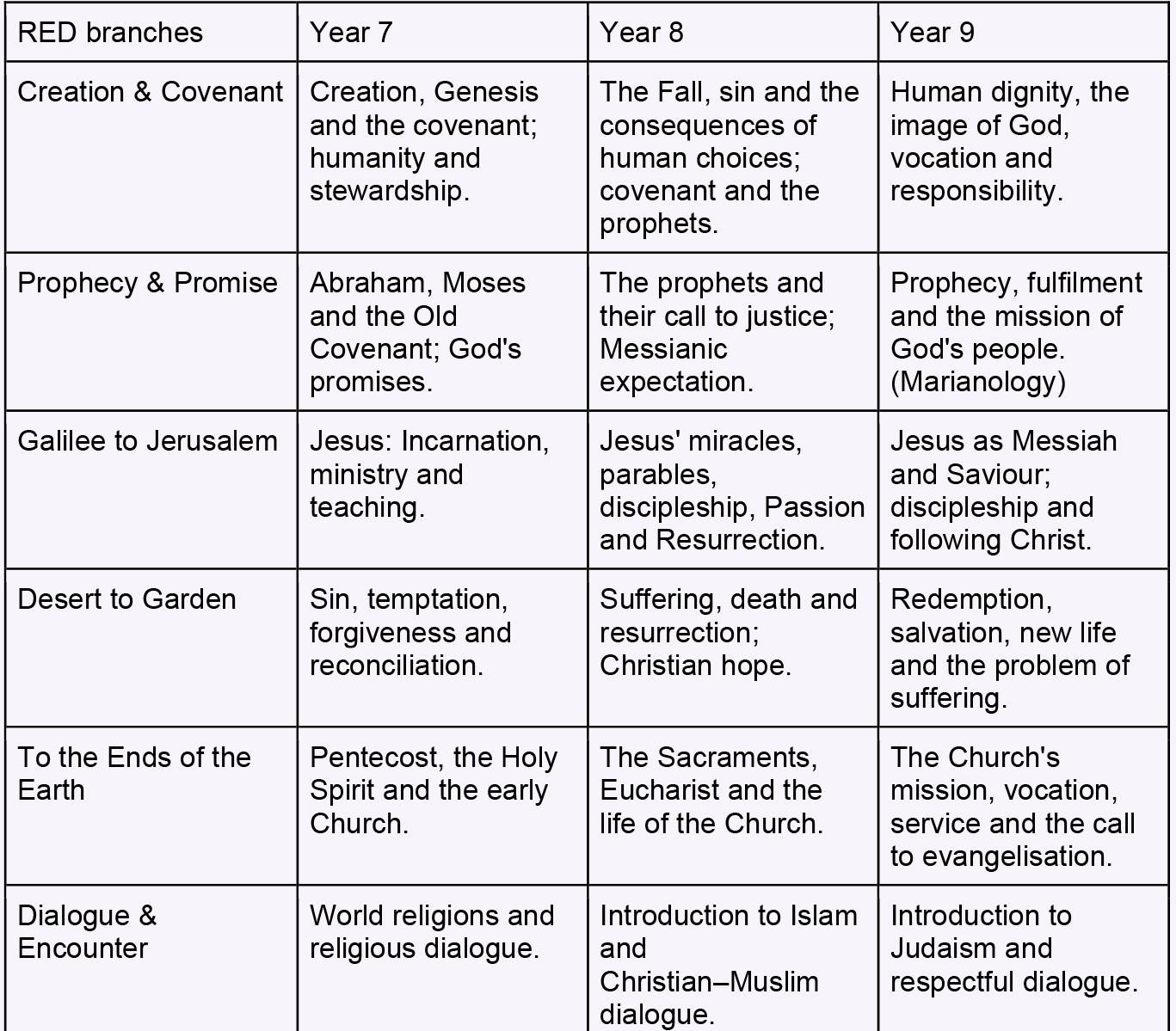
All of the content of the syllabus is informed by The Religious Education Curriculum Directory 2023. The syllabus also takes into account the Programme for Key Stages 1 & 2.
The syllabus has been devised to enable the children to become more aware of their place in God’s creation. Each person is made in the image and likeness of God, and is called to live life and live it to the full (John 10:10).
The lower school process is very much incarnational in its approach. God is revealed in the everyday experiences of life, in the events of our lives, in our relationships, and in the witness of others. He is also seen in the traditions and story of our Church, the Roman Catholic Church, a story, which is worth re-telling, whilst recognising that he is also present in the traditions of other denominations. The child’s own experiences are therefore to be seen not just as important, but also as essential to the whole process of Religious Education, since God is at work through each of our ’faith stories’. In the lower school there is a lot of opportunity for discussion and prayer, but we recognise the need for input and the importance of knowledge if the students are to be enriched, and if their vision is to be widened.
We also need to educate in the culture and religion of others, and Judaism, Hinduism and Islam are all studied. Throughout the Key Stage 3 curriculum we endeavour to share the Salesian Ethos with our students. It is of the highest importance that all Thornleigh Salesian College students understand and appreciate that they are members of an international family. Whether they are Catholic, Christian or of another religious tradition, being a student at our school gives each person the permission to be called ‘students of Don Bosco’. It is our aim and that of the chaplaincy and pastoral teams to equip them with this knowledge. We do this by teaching Salesian spirituality in Year 7, taking Year 8 students on retreat and inviting Year 9 students to participate in feast day celebrations. Students in Year 9 / 10 also have the opportunity to visit Rome.
Key Stage 4
Subject Intent
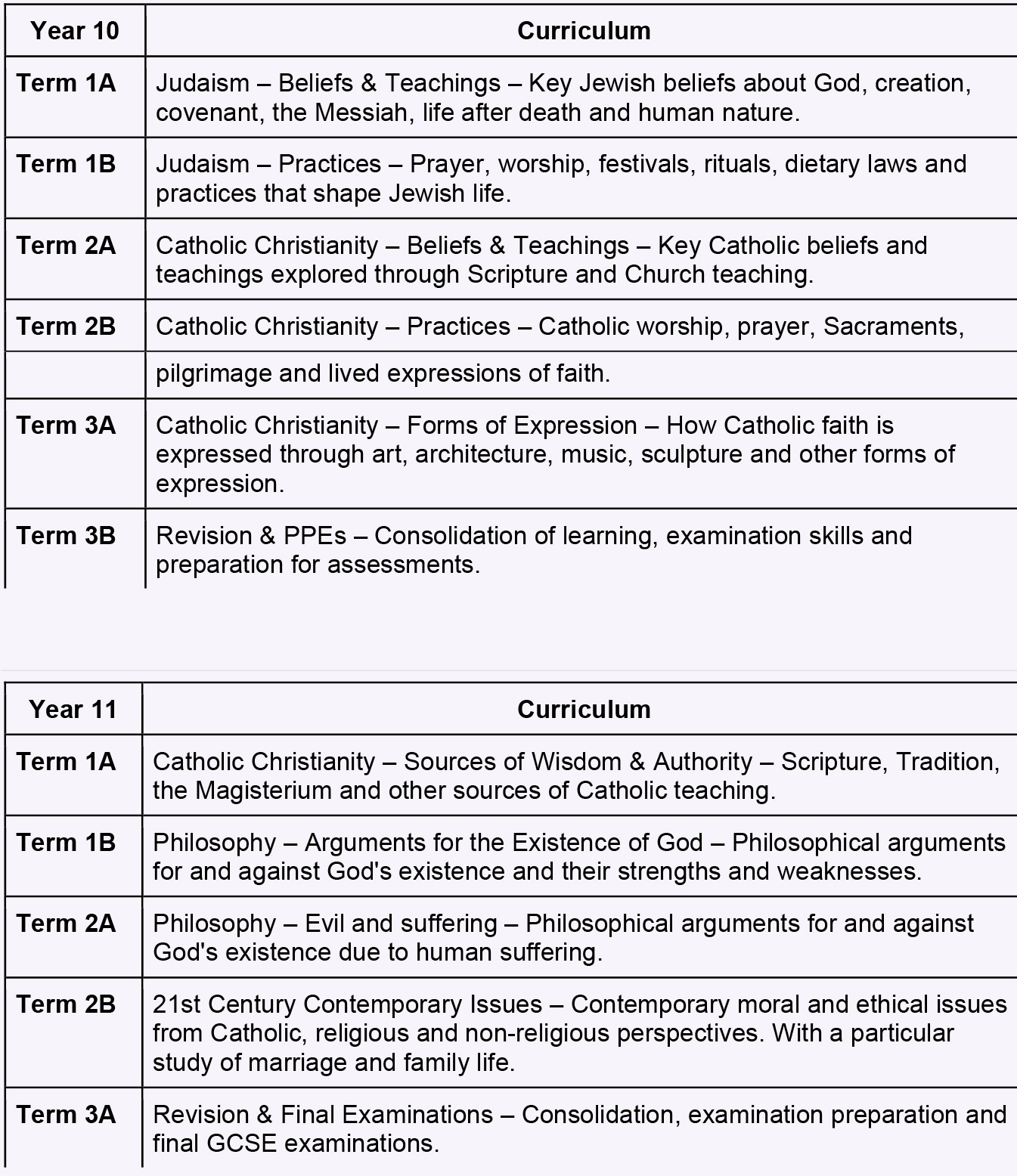
In Years 10 and 11, a more rigorous academic approach is followed, with all students following a GCSE EDEXCEL SPEC A (JUDAISM) course.
Whilst recognising this, in our school community, we still acknowledge that although the emphasis is still very much on the academic, catechesis and evangelisation will be at the very heart of what we are trying to achieve through the course. The course enables the students to become more aware of the various branches of Christianity, and hopefully to respect the differences that exist. It also helps them to focus on some very important social and moral issues of the day, and to come to some firm conclusions of their moral stance in the light of the Gospel message. students are taught 5 lessons (1 hour / 55 mins) over two weeks (10% curriculum time). It is expected that staff, in preparing for lessons, will keep in mind the need for VIP-Variety, Interest and Progression. In line with continuing their Salesian spirituality, key stage 4 students are invited to become leaders, and support the younger students in a variety of activities.
Key Stage 5
Subject Intent
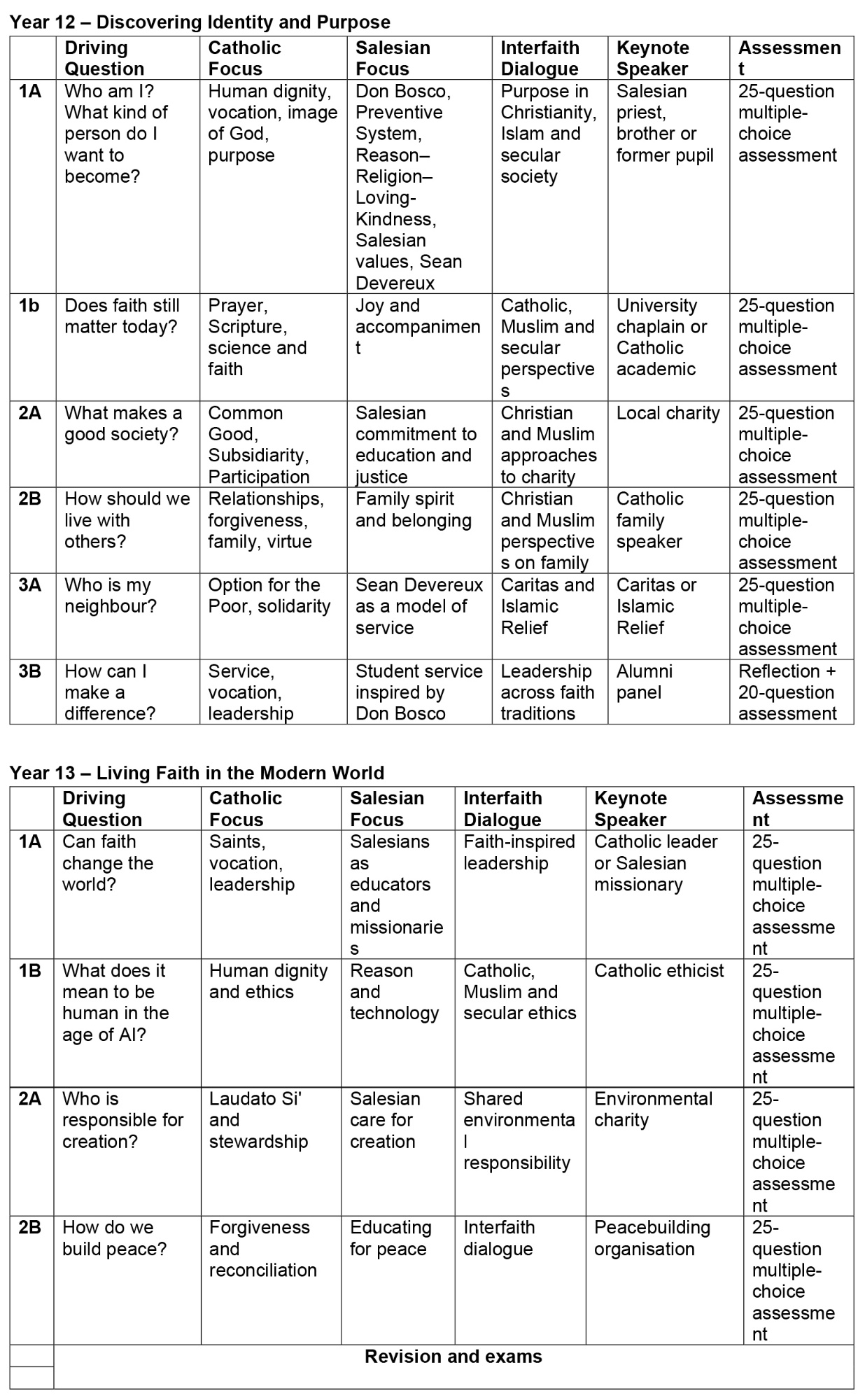
In Years 12 and 13, we offer an A Level in Religion, Philosophy and Ethics. This course helps students develop their interest in, and enthusiasm for, a rigorous study of RPE and its relation to the wider world. The AQA specification encourages students to reflect on and develop their own values, opinions and attitudes in the light of their learning. Students will have an opportunity to study in depth Chrisitans teachings, including textual, theological, historical, ethical, phenomenological and philosophical perspectives.
We also offer all sixth form students Core RE; one lesson every two weeks, which follows the same branches as the new Religious Education Curriculum Directory.
Worship, Liturgy and Retreat
Worship and Liturgy
We recognise that as a Catholic, Salesian school, our difference lies in the fact that we are a worshipping community. In devising liturgical experiences for the students, we remember that liturgy is primarily for those who desire to celebrate, and is essentially a free activity. However, it is also realised that younger students do also need direction and encouragement.
We worship as a whole school community with an Advent Service and an End of Year Celebration, as well as Holy Day Masses. We celebrate a Family Mass, for Year 7 students and their families, in the autumn term, and a Leavers’ service, for Year 11 and 13 students, in the Summer term. Year groups will also celebrate Class Masses during the year. There are also weekly Voluntary Masses in the Chapel throughout the year. We have excellent support from both our local clergy and the Salesian community.
The experience of prayer is an integral part of Religious Education and school life at Thornleigh, and all students and staff are given the opportunity to participate in Advent and Lenten Services. All students and staff are invited to Morning Prayer, and there is Staff Prayer for Advent and Lent on Monday mornings. The Sacrament of Reconciliation is also offered to all during Advent and Lent.
It is part of the vision that all staff in the school would become actively involved in preparing for whole school masses and assemblies, and we, as a department, are here to support staff with ideas when needed, but we recognise that the worshipping life of the school is not something that ought to be monopolised by the Religious Education department in a Catholic school.
Retreat
Retreats are an essential element of the life of our school. Time away from the hectic academic life supports and promotes a holistic view of life. At the start of each year, our new intake of students participate in a retreat experience that is led by the chaplaincy team with the support of the Religious Education department and the pastoral team. Other year groups have the opportunity to participate in a 3-day residential retreat, usually at Savio House, the Salesian retreat centre, but occasionally other locations.
Prayer
Prayer obviously forms an important part of the life of the department. It is hoped that apart from ‘form’ time and assembly, the students will be encouraged to pray at certain times during the day. Our lesson begins with students standing and praying our school prayer; this can be as a whole class, led by the teacher or led by a student. Our school prayer is:
Heavenly Father,
be with us as we live, learn,
and grow together.
Inspire in us a spirit of
respect, understanding, affection, and humour,
so that all can know that they are
valued, loved, and cherished.
With Mary as our guide,
encourage us to be more like Jesus,
today and every day.
Amen
St John Bosco, pray for us.
Religious Education Department - Marking and Feedback Policy
The Religious Education Department is committed to ensuring that marking and feedback are purposeful, consistent, and support the academic and personal development of all students. This policy outlines the expectations for marking, feedback, student engagement, and departmental quality assurance processes.
Assessment Books
- All formal assessments must be marked in-depth and recorded in the designated assessment books.
- Marking should provide clear, constructive feedback that identifies strengths and areas for improvement, in line with departmental assessment criteria.
- All marks from both formative and summative assessments must be recorded on the school’s data tracking system (Pupil Progress) in accordance with the assessment calendar, to ensure accurate reflection of pupil progress.
- Feedback should be directly linked to the particular topics being assessed. For Key stage 4 and 5 that is the exam board's descriptors and for Key stage 3 the Religious Education directory.
- Teachers are required to mark in green pen.
Homework
- All students, each half term, will receive a homework booklet.
- All homework must be set on classcharts and the booklet also uploaded to google classroom. It is the students responsibility to care for and organise their time.
- All homework must be marked with written feedback that includes
- Corrections, where necessary
- Positive praise to reinforce effort and progress
- Students must be given the opportunity to respond to feedback, helping to consolidate their understanding and address areas of development.
- Teachers are required to set one piece of homework for every student once a week. This is inline with the whole school homework policy.
- Key stage 3 homework should take up to 30 mins to complete
- Key stage 4 homework should take up to 45 mins to complete
- Key stage 5 homework should take up to 60 mins to complete.
Classwork (Workbooks)
- Classwork should be marked through live marking during lessons.
- Teachers are expected to actively circulate the classroom during written tasks to check for understanding, correct misconceptions, and provide immediate feedback.
- Live marking supports timely intervention and encourages a responsive, engaging learning environment.
- Workbooks, ordinarily stay in school.
Student Response and Feedback
- Students are required to use red pen for all feedback-related tasks, including:
- Responding to teacher feedback (therapy tasks)
- Completing corrections
- Reflecting on their work
- Participating in peer and self-assessment
- The use of a red pen ensures consistency across the department and enables teachers to clearly identify student response and engagement with feedback. This also meets the school marking policy.
Peer and Self-Assessment
- Peer and self-assessment should be used regularly to promote metacognitive skills and student ownership of learning.
- All such tasks must be completed in red pen.
- Clear success criteria should be provided to ensure feedback is focused, relevant, and supportive of progress.
Quality Assurance
- The Head of Department and Key Stage Leaders will lead a half-termly Quality Assurance (QA) process to support consistency, share effective practice, and raise standards across the department.
- QA activities will take place in one of the following formats:
- Review of students’ books/folders
- Lesson visits and informal learning walks
- Moderation of assessments across year groups
- Feedback from QA activities will be delivered verbally, with key points recorded to inform departmental training and the sharing of good practice.
- The QA process is developmental in nature and is intended to support professional growth and a culture of continuous improvement across the department.
Parents’ Evenings
Each year the group has one Parents’ Evening annually.
- KS3 evenings usually happen in Spring or Summer terms.
- KS4/5 evenings usually take place in Autumn or Spring terms.
Parents book appointments with you in advance via School Cloud. Parents’ Evenings run from 4pm to 7pm - you are expected to be available for at least 3 hours during this time.
Building positive relationships with parents is important. Don’t hesitate to contact parents for praise or to discuss concerns - open communication helps support student progress.
Reports and Data
Throughout the year attainment reports are to be completed and guidance is sent from the Senior Leadership team on what is required at each data drop. For KS3 these are based on Learning thresholds outlined by the school. At KS4 and KS5 these are fine grades. You will also be asked to report students' learning characteristics.
Meetings
- All meetings are laid out in the school calendar.
- After school meetings will take place on a Wednesday, some will be the whole school and others will be in the department.
- Sometimes this may be a full meeting (which aims to finish by 4:30) but may be a short meeting allowing time for the completion of a task.
- Every other Tuesday there is a short meeting at 8:30am.
Behaviour for Learning
Following the preventive system of Don Bosco and the school’s behaviour system the department policy is as follows:
- First instance / small issue = Verbal warning or reminder of expectations
- Repeated small issue (e.g talking) = C1 issued + logged on ClassCharts
- More serious issue or does not respond as a result of a C1 (e.g repeated hwk not done) = C2 issued + logged on ClassCharts. This sort of behaviour may also warrant a break or lunch detention.
- Serious issue (refusal to follow instructions) or no improvement after C2 = C3 issued. This must be followed up with a department sanction normally an after school detention for 30 minutes.
- If the students fail to turn up, you must notify home and this will then be passed to the Head of Department.
- Any student who is consistently preventing you from teaching/other students from learning should not be tolerated.
- In the case of a student needing to be removed from a lesson, teachers should follow the RE behaviour support plan.
- A restorative conversation must take place, preferably on the same day, if not during the assigned detention.
Please Remember
- All behaviours incidents must be logged on class charts
- C2 and C3 behaviours must be followed up with a sanction
- Afterschool Detentions need 24 hrs notice or a parents permission for same day detention. This is only after agreement with HOD.
- If a student is a persistent problem, please speak to others in the department (who may know the student) and their tutor.
- Contacting home is an excellent way to often nip poor behaviour in the bud. Please check with their Learning Mentor before you contact home (in case there is a bigger issue)
- phone calls home are to be recorded on the spreadsheet, so we can keep track of these.
- The Head of Department detention will take place on Thursday nights.
- Subject reports are also available from the Head of Department.
Presentation of Work
- All books must have a form of a Learning Programme/ Learning Log LP booklet stuck into their books at the start of each new topic.
- Each lesson’s work should have the date, title and classwork or homework underlined with a pen and ruler.
- Students' work should be done in black ink. Therapy time work is completed in red ink.
- Poorly presented work should not be tolerated. Any such work should be identified as soon as possible and then repeated.
- All worksheets must be stuck in.
Assessments
- all students will have an assessment book.
- all formative and summative assessments are to be completed in these books.
- Marking of these assessments will be directed by the key stage leader.
While there are areas in the Religious Education curriculum, which are easily assessed objectively, there are others, which are just as important, if not more so, which cannot be assessed.
There is a danger that those areas which are testable gain a superior position in the students’ minds, and that this demeans the areas which cannot be tested. With the best will in the world, we tend to teach tests and examinations if they are in place, and a real danger is the more reflective and personal parts of the Religious Education curriculum will be given less time.
Assessment should:
- develop the students’ own sense of value and esteem, by acknowledging achievement. It may be formative or diagnostic, but always positive.
- Monitor progress and celebrate achievement of individual students.
- Monitor areas for development and determine the next step for individual students.
- Evaluate teaching and inform planning.
- Provide summative information for parents, teachers and others.
Assessment - Key assessments are identified for each teaching group and all key assessments are put into the shared area and discussed at department meetings. These marks allow the Head of Department and individual teachers to monitor student progress and identify targets for improvement. Assessments and KAP can be found in the ‘Big Picture’ and Scheme of learning documents.
Key Stage 3
The nature of the work will obviously determine the various skills that the student displays. For example, the task may be biassed towards investigative skills, collecting information and recording it, or it may be looking for evidence of understanding of certain concepts. It may be asking for students to evaluate a wide range of issues, to formulate coherent arguments, or to justify personal opinions. The work may be in written form, or art form. You may wish to assess a student’s ability to work in a group, or give a mark for a role-play that he/she has been a part of, or an idea for a liturgy that he/she has come up with. It is important to remember that assessment must be pre-planned in line with the learning log, which indicates the level of work that each student has attained.
Key Stage 4
For GCSE Religious Studies, final assessment is based on 100% examination (3 papers). Prior attainment data (CATs, SATs) provide information about students’ progress and achievement, and are useful in providing target grades and mentoring. Target grades are agreed with students in November (Year 10), and regular target checks occur, in line with school policy.
Predicted GCSE grades are given to the exam board in February (Year 11). GCSE examinations take place in June (Year 11).
Assessment of work
Monitoring
The department’s work is monitored to raise standards of teaching and learning. The emphasis throughout is on the sharing of good practice within the department. Setting targets to secure improvement is another reason for monitoring. It is an important role of the Head of Department to monitor all aspects of the department, but it is a responsibility of all members of the department to contribute to this process.
The Line Manager monitors the Head of Department’s role.
Aspects of the Department to be monitored:
Schemes of Work - A regular item on Departmental meetings, to monitor progress and adherence to schemes of work.
Teaching and Learning - There is an open door policy and the department feels comfortable going into each other’s lessons.
Assessment - Key assessments are identified for each teaching group and all key assessments are put into the shared area and discussed at department meetings. These marks allow the Head of Department and individual teachers to monitor student progress and identify targets for improvement.
Marking & Homework - A department meeting is used to look at students’ exercise books, in order to examine the quality and standard of marking, adherence to the schemes of work, setting of homework and student progress. It is a productive way of sharing good practice and providing encouragement for a better marking standard.
Formal assessments will take place as follows:
- KS3 = Once every half term. Other work set at staff discretion. Ideally questions should be as advised by the curriculum directory.
- KS4 = Ideally an exam question or preparation for every lesson. Once every half term an end of unit assessment following the GCSE question format.
- KS5 = Ideally some form of exam style question each week. Two PPE exams.
Departmental Review and Planning
Periodically, the department will review. This will be done collaboratively, all teachers will have a voice and will be listened to. This does not mean that all ideas and suggestions will be taken on board. At the heart of our review and planning process will always be the benefit and betterment of our students.
Staff Absences and Setting of Work
In cases of absence planned in advance, teachers should inform the Head of Department with all relevant details at the earliest opportunity. For other than intended absences, every reasonable effort should be made to inform the Head of Department, presumably by telephone and directly if at all possible, either during the evening preceding the day of absence, or on the morning of the actual absence, at which time the School Office staff should also be informed.
In all but extreme personal circumstances, work should be set for each of the student groups concerned. This can be set as an assignment on Google Classroom or emailed to the Head of Department to print and set for cover staff. Set work should be appropriate to their ages, abilities and experiences in Religious Education, be relevant to their current, recent and/or impending learning, and should be clearly and unambiguously explained. It would be appreciated that the work set is of such nature as to cause a minimum amount of inconvenience for a covering teacher, in terms of activity and materials used. There must be enough work set. Most covered classes will work in silence in the hall on chromebooks therefore plenty of work must be set.
The Head of Department will delegate to key stage leaders, responsibility for providing the resources required, and for liaising with the teacher who will be ‘covering’ the lesson. At the close of the lesson, the Head of Department or the delegate will collect the work and resources, discuss the lesson with the ‘covering’ teacher (if time allows) and ensure that notes have been made regarding the students’ work and behaviour, which will subsequently be passed to the absent colleague.
In case of any protracted absence, the Head of Department will liaise with the Senior Teacher responsible and endeavour to arrange for a specialist supply teacher to be employed, who would be made welcome and offered any help and advice necessary by all the members of the Department.
Guidance for Teaching Staff
- Please do not allow students out of lessons - if a student has a medical reason to be out of class they will have a medical / toilet pass / time out card. If another teacher wants them, someone will come to class to get them.
- The only drink allowed in lessons is water. This should only be a small bottle.
- Mobile phones should not be seen or used in lessons. Under no circumstances can students listen to music on their phones when they work.
- Students can be sent out of lessons if they are causing problems, but this is only a short term solution. They must be brought back into your lesson (or placed into another lesson) within a couple of minutes. (Please see RE behaviour support plan)
- Ensure students have enough time for lunch if you give them a lunchtime detention.
- At the end of the day please refrain from keeping students back without prior arrangement. Many buses start leaving as early as 3:20pm.
- Please ensure that any issues with ICT / maintenance are logged via the desktop with the ICT dept / site office.
- Individual copying can be done via your ID card. Please let reprographics know in advance if you want any bulk copying done, If you need copying for more than class worksheets you must get authorisation from the Head of Department.
- Please ensure that non-attendance at lessons at KS5 is always logged on Classcharts.
- A Quality Assurance schedule for each ½ term will be issued. Please ensure that the books requested are given to the identified staff as soon as possible.
- Please ensure that in your planner / class lists / seating plans you have clearly identified Pupil Premium students, students with SEN, students who are EAL and MAPS students.
- Please ensure that the ONLY email address you share with students is your school email - Never contact them via your private email accounts.
- The main data analysis tool we use in school is Sisra Analytics.