







Graphics
Subject Introduction
At Thornleigh, the Art Department is dedicated to providing a rich, inclusive, and dynamic curriculum that not only fulfills the requirements of the National Curriculum but also plays an integral role in forming creative, confident, and thoughtful citizens of the future.
We believe that the study and practice of art is essential to the development of critical thinking, problem-solving skills, and an appreciation for diverse cultures, perspectives, and histories. Our intent is to foster an environment where every student, regardless of background or ability, can explore their creative potential and express themselves in meaningful ways.
Our curriculum ensures that art education is accessible to all, with an emphasis on building skills in visual communication, conceptual thinking, and artistic technique. We aim to inspire students by giving them opportunities to explore a wide range of media, styles, and themes, while also challenging them to think critically about the role of art and design in society. By embedding the principles of the National Curriculum in every aspect of our lessons, we ensure that our students not only acquire the technical skills needed to succeed in the subject but also understand the broader context of art in the world around them.
We are committed to ensuring that all students, regardless of their individual needs or backgrounds, feel empowered to participate in art lessons. For example, we provide differentiated tasks and scaffolded support for students with different abilities, ensuring that each student can engage meaningfully with the subject. This might include offering visual aids, adaptive tools, or alternative methods of communication for students with additional learning needs. We aim for all students to leave each lesson with a sense of accomplishment, building their confidence and curiosity about art.
Through the exploration of diverse artists, art movements, and global cultures, we encourage students to engage with issues of identity and global citizenship. We might incorporate discussions on how art has been used historically to shape social movements or raise awareness about global issues such as climate change, racism, or gender equality. This helps students understand the power of art as a tool for societal change and encourages them to think critically about their own role in shaping the future.
Our curriculum encourages students to develop their ability to think critically about their work and the work of others. Through regular peer and self-assessment activities, students are taught to reflect on their artistic decisions and articulate their thought processes. This reflective practice not only improves their artistic skills but also equips them with the ability to analyze and evaluate information critically, a skill that is essential for their future roles as informed citizens.
Building on KS2
Key Stage 3 Art lessons build on the skills and knowledge acquired in Key Stage 2 by deepening students' understanding of artistic techniques, fostering critical thinking, and expanding their ability to engage with more complex ideas and concepts in art. While the Key Stage 2 Art and Design curriculum lays the foundation for creativity, technical skills, and the appreciation of art, Key Stage 3 offers students the opportunity to refine and develop those skills further in a more structured and challenging context. Consideration also needs to be given to the varying experiences of students from different backgrounds, different primary schools and areas within Bolton, with an initial focus on the formal elements given to help identify a baseline of understanding and skill within each student.
In Key Stage 2, students are introduced to basic techniques like drawing, painting and sculpture. They begin to experiment with different materials and understand the basic principles of art, such as line, shape, texture, pattern, tone and colour. At Key Stage 3, these foundational skills are built upon by introducing more advanced techniques and a broader range of materials.
- Drawing: While students at Key Stage 2 might focus on simple sketches and observational drawings, in Key Stage 3, they are encouraged to experiment with more complex forms of drawing, such as life drawing, perspective, and tonal shading.
- Painting: Students refine their understanding of colour theory, learn about mixing primary and secondary colours, and experimenting with different brush techniques and mediums, such as acrylics and watercolors, to create more detailed and layered works.
- Sketchbook Presentation and Folder work: Students will learn additional skills in presenting sketchbooks and folder work, moving towards the requirements at GCSE level and beyond, showcasing skills in mixed media, collage etc within their work.
At Key Stage 2, students are taught to follow basic steps in creating artwork, such as planning, developing ideas, and evaluating their work. They are introduced to the concept of working through a creative process. Key Stage 3 Art lessons encourage students to approach art-making more independently, integrating the following: Research and Experimentation: Students are encouraged to conduct independent research into various artists, art movements, and cultural influences. They learn how to use this research to inspire and influence their own creative decisions. In-depth Development of Ideas: Students are tasked with developing and refining their ideas over a series of lessons, using sketchbooks to explore initial concepts, experiment with different compositions, and refine their techniques.
At Key Stage 2, students are introduced to basic art history, learning about different artists, styles, and cultural movements. Key Stage 3 broadens this historical knowledge by delving into art history with more depth: Cultural Contexts and Movements: Students explore different art movements such as the Renaissance, Impressionism, Surrealism, or contemporary art, learning to identify key characteristics, techniques, and the socio-political contexts in which these movements emerged. Global and Contemporary Art: There is also an increased focus on art from a wider range of cultures and periods.
While Key Stage 2 students may focus more on producing art based on straightforward observation or their own experiences, Key Stage 3 challenges them to develop more sophisticated conceptual frameworks for their work. Conceptual Thinking: At Key Stage 3, students are encouraged to explore more complex ideas, themes, and emotions through their artwork. They may be asked to respond to prompts that require abstract thinking or to create art that explores social, environmental, or political issues. Personal Expression and Identity: Students are encouraged to use their work as a means of personal expression, allowing them to explore their own identities, experiences, and interests in more meaningful ways.
Exploring Styles and Media: At Key Stage 3, students are given more freedom to explore their individual artistic voice. They experiment with different media, styles, and methods, from traditional to contemporary techniques, allowing them to find the medium and style that best suits their vision.
The Key Stage 2 curriculum may introduce students to basic digital tools for creating art, such as simple photo editing software or digital drawing tools. In Key Stage 3, digital art becomes a more prominent aspect of the curriculum. Students might use programs like Adobe Photoshop to create digital compositions, experiment with graphic design, or explore digital photography.
Key Stage 3
Subject Intent
Aims
- produce creative work, exploring their ideas and recording their experiences
- become proficient in drawing, painting, sculpture and other art, craft and design techniques
- evaluate and analyse creative works using the language of art, craft and design
- know about great artists, craft makers and designers, and understand the historical and cultural development of their art forms
Key Stage 3 Curriculum Requirements
Pupils should be taught to develop their creativity and ideas, and increase proficiency in their execution. They should develop a critical understanding of artists, architects and designers, expressing reasoned judgements that can inform their own work.
Pupils should be taught:
- to use a range of techniques to record their observations in sketchbooks, journals and other media as a basis for exploring their ideas
- to use a range of techniques and media, including painting
- to increase their proficiency in the handling of different materials
- to analyse and evaluate their own work, and that of others, in order to strengthen the visual impact or applications of their work
- about the history of art, craft, design and architecture, including periods, styles and major movements from ancient times up to the present day
Teaching and Learning Approaches
Effective teaching and learning approaches are essential for fostering student engagement, skill development, and deep understanding in Art and Design. These approaches must be tailored to Art’s creative and exploratory nature, ensuring students not only master techniques but also develop critical thinking, independent inquiry, and an appreciation of art's role in society.
Explanations in Art and Design must be clear, concise, and scaffolded explanations that connect theory with practice. These are essential for guiding students through complex artistic concepts and techniques. Teachers should provide step-by-step instructions when introducing new techniques or tools, ensuring all students understand the practical application of what they are learning. For example, when demonstrating how to mix colours or how to approach a drawing exercise, the teacher should explain the method in simple terms, give examples of successful outcomes, and outline the key concepts behind the technique (e.g., colour theory, proportion, or texture).
Theoretical knowledge, such as the study of famous artists or art movements, should be integrated into practical tasks. For example, after studying the work of Picasso or the Cubism movement, students should be given a project where they experiment with elements of cubism in their own work. This helps students understand the "why" behind techniques and encourages deeper engagement. Teachers should use visual aids such as slides, diagrams, or visualiser demonstrations (live modelling) to reinforce explanations, ensuring clarity and accessibility for all students.
Modelling
Modelling involves demonstrating techniques, approaches, or the process of creating art to make abstract concepts tangible and accessible for students. Teachers should model the creation of artwork, starting with basic steps and progressing to more complex actions. For example, when teaching how to sketch or paint, a teacher might start by drawing a simple shape using the visualiser, showing students how to break down the process into manageable stages such as, sketching outlines first, then adding shading, then refining details.
Modelling involves not only demonstrating techniques but also “thinking aloud” to share the decision-making process. For example, when creating a composition, a teacher might explain why certain colours or brushstrokes are chosen and how these decisions contribute to the final artwork’s meaning or style. This models reflective thinking and problem-solving, crucial aspects of artistic practice. Teachers should also demonstrate the importance of experimenting with different methods or materials. For instance, when introducing a printmaking technique, a teacher might show various textures and effects that can be achieved, encouraging students to experiment and find their own voice.
Questioning
Effective questioning fosters critical thinking and helps students articulate their creative decisions, reflections, and understanding of the subject matter. Questioning should be purposeful and open-ended, encouraging students to explore their ideas, make connections, and critique their own work. Examples of effective questions include:
"What materials do you think would work best for this idea and why?"
"How does this piece of art make you feel? What do you think the artist was trying to communicate?"
"What challenges did you face when creating this, and how did you overcome them?"
Teachers should also use questioning to guide students towards deeper understanding. For instance, after a student shares their work, the teacher might ask, "What choices did you make here, and how does that contribute to the overall meaning of your piece?" This encourages students to reflect critically on their choices and gain greater insight into their own creative process. Encouraging students to question one another's work fosters collaborative learning and helps them develop both their critical thinking and communication skills. Peer critiques should be structured so that students can give constructive feedback, asking questions like, "What do you think works well in this piece?" and "What could be improved?"
Feedback
Feedback should be constructive, focused on improvement, and supportive of the creative process, helping students to reflect, refine, and push their artistic boundaries. Marking and feedback should go beyond just evaluating the final product. Teachers should focus on progress, effort, creativity, and technical improvement. Comments should provide guidance on how students can improve their work, both technically and conceptually. For example, a teacher might comment:
"Your use of colour here is bold and dynamic. Consider exploring how the background could complement the foreground more."
"You've made great progress in developing your drawing skills. Next, try experimenting with shadow to create depth."
Regular, formative feedback should be provided throughout the process, not just at the end. This helps students adjust their approach and enhances the learning experience. For example, after an initial draft or sketch, a teacher might give feedback on areas of improvement, encouraging students to experiment and revise. Encouraging students to assess their own work and that of their peers helps them develop their reflective skills. Structured assessment grids can guide this process.
Ensure a green pen is used for all feedback and a red pen for student responses in accordance with the whole school policy.Feedback should emphasize improvement and learning from mistakes. This encourages students to embrace the process of trial and error as part of developing their artistic skills. Comments should emphasize that all progress, no matter how small, is valuable.
In Art and Design, long-term memory is crucial for students to retain and apply techniques, concepts, and knowledge across a range of projects. This can be reinforced through regular review, repetition, and application. To promote this, students should be regularly revisiting key concepts and skills. Certain foundational techniques (e.g., shading, color mixing, composition) should be revisited regularly in different contexts to ensure mastery. When teaching new content, teachers should make connections to prior learning. For instance, when exploring new media, teachers might reference past projects or artists that relate to the current topic.
At the end of a unit, students should have opportunities to reflect on their learning journey. This might include revisiting earlier pieces of work and discussing how their understanding has deepened or how they’ve applied new skills. Art and Design inherently engages multiple learning styles, with a focus on visual and tactile learning. Teachers should provide plenty of opportunities for students to create visual representations of their learning, whether through sketches, mind maps, or mood boards, which reinforces memory through hands-on practice.
Homework
The purpose of homework set for Key Stage 3 Art is multifaceted, aiming to reinforce learning, encourage independent exploration, and deepen students’ understanding of both practical and theoretical aspects of the subject. It provides students with opportunities to extend their skills, reflect on their work, and develop creative ideas outside the classroom. Homework should be thoughtfully designed to support the curriculum, challenge students to think critically, and help them build their artistic confidence and autonomy. Homework allows students to consolidate what they've learned in class, providing an opportunity to practice techniques, explore concepts in more depth, and refine their skills. Tasks may be designed to reinforce or build upon practical skills learned in class, such as sketching, shading, colour mixing, or creating textures.
Art often requires ongoing practice and experimentation outside of lesson time. Homework fosters students' independence by encouraging them to work on their own ideas, manage their time, and take initiative in their creative process.
In addition to developing technical skills, homework provides students with the chance to engage with more abstract or conceptual ideas, which is important for developing their understanding of art history, cultural contexts, and the meaning behind artistic practices. Assignments can require students to research different artists, movements, or art forms and reflect on how these influenced their own work.
Homework should be set inline with the whole school policy which is once per fortnight (30 minutes) or if completing a sustained project less frequency and greater emphasis on developing ideas and final product, Year 7 insect task for example may fall into this category.
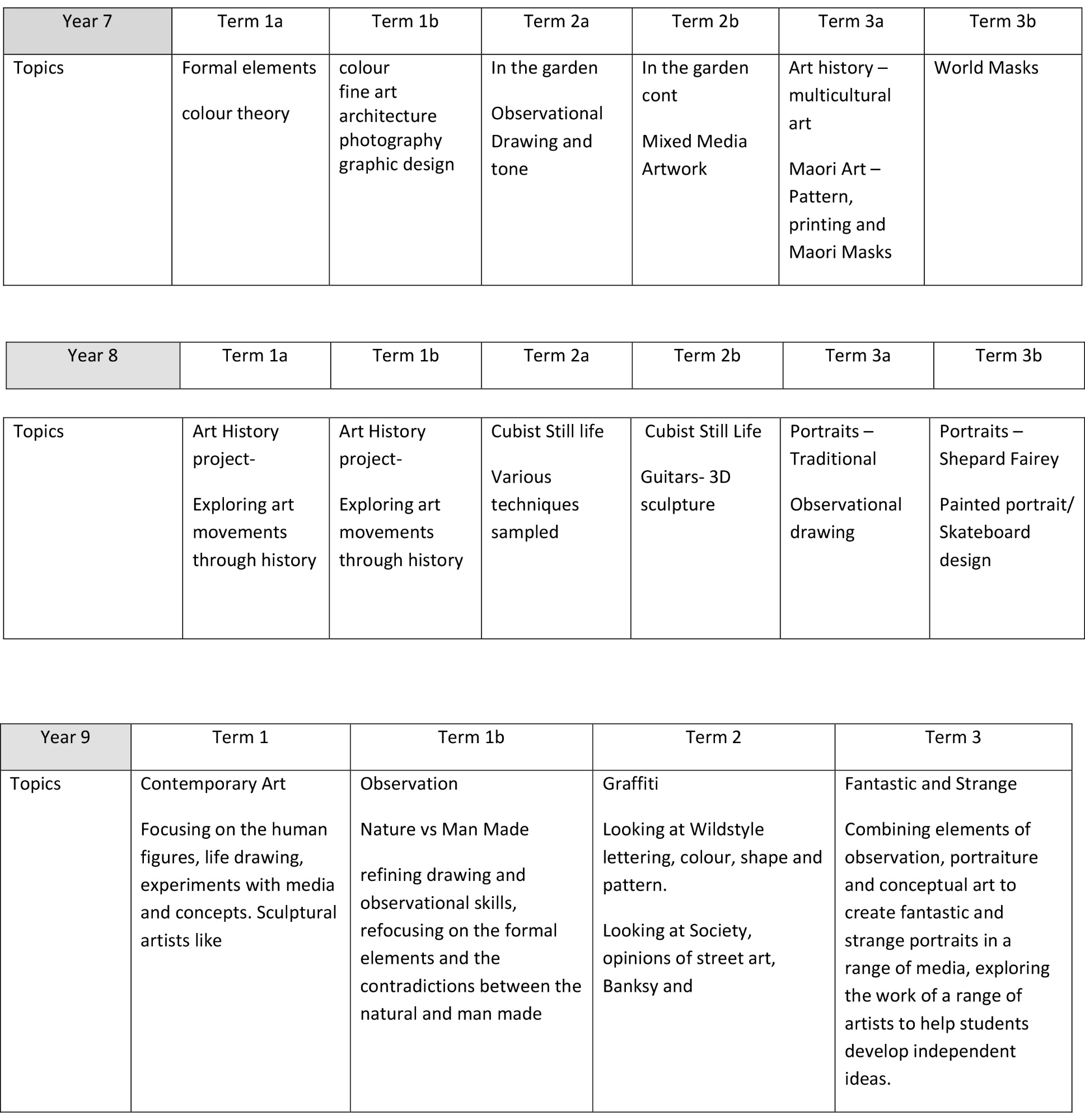
Key Stage 3 Art and Design Overview Map
Key Stage 4
Subject Intent
Our GCSE exams in Graphic Communication (Art and Design) include questions that allow students to demonstrate their ability to:
- bring together the knowledge, understanding and skills acquired during their course of study
- select and present work produced during their studies to demonstrate attainment, reflecting a holistic approach to coverage of the assessment objectives
- make connections between knowledge, understanding and skills when engaging with sources such as the work of artists, craftspeople and designers and when applying working methods and processes appropriate to one or more of:
- a starting point, stimulus or issue-based concern
- a design brief or problem requiring a solution
- a task which specifies an outcome such as an image, artefact or product.
There is synoptic assessment in both components of the GCSE that provides rigour and presents opportunities for students as follows:
In Component 1 (portfolio) students develop responses to initial starting points, project briefs or specified tasks and realise intentions informed by research, the development and refinement of ideas and meaningful engagement with selected sources. Responses will include evidence of drawing for different purposes and needs and written annotation. (60%)
In Component 2 (externally set assignment) students respond to a starting point provided by AQA. This response provides evidence of the student’s ability to work independently within specified time constraints, realise intentions that are personal and meaningful and explicitly address the requirements of all four assessment objectives. (40%)
Aims and Learning Outcomes
Courses based on this specification should encourage students to:
- actively engage in the creative process of graphic design in order to develop as effective and independent learners, and as critical and reflective thinkers with enquiring minds
- develop creative, imaginative and intuitive capabilities when exploring and making images and products
- become confident in taking risks and learn from experience when exploring and experimenting with ideas, processes, media, materials and techniques, both by hand and digitally.
- develop critical understanding through investigative, analytical, experimental, practical, technical and expressive skills
- develop and refine ideas and proposals, personal outcomes or solutions with increasing independence
- acquire and develop technical skills through working with a broad range of media, materials, techniques, processes and technologies with purpose and intent in traditional and digital areas.
- develop knowledge and understanding of graphic design in historical and contemporary contexts, societies and cultures
- develop an awareness of the different roles and individual work practices evident in the production of graphic design in the creative and cultural industries
- develop an awareness of the purposes, intentions and functions graphics design in a variety of contexts and as appropriate to students’ own work
- demonstrate safe working practices in graphic design both traditional hand made skills and digital design and editing skills.
Assessment objectives (AOs) are set by Ofqual and are the same across all GCSE Art and Design specifications and all exam boards.
The exams and non-exam assessment will measure how students have achieved the following assessment objectives:
- AO1: Develop ideas through investigations, demonstrating critical understanding of sources.
- AO2: Refine work by exploring ideas, selecting and experimenting with appropriate media, materials, techniques and processes.
- AO3: Record ideas, observations and insights relevant to intentions as work progresses.
- AO4: Present a personal and meaningful response that realises intentions and demonstrates understanding of visual language.
The ability to handle materials, techniques and processes effectively, skilfully and safely underpins all the assessment objectives. It is important in enabling students to develop a personal language, to express ideas and to link their intentions to outcomes in a confident and assured manner.
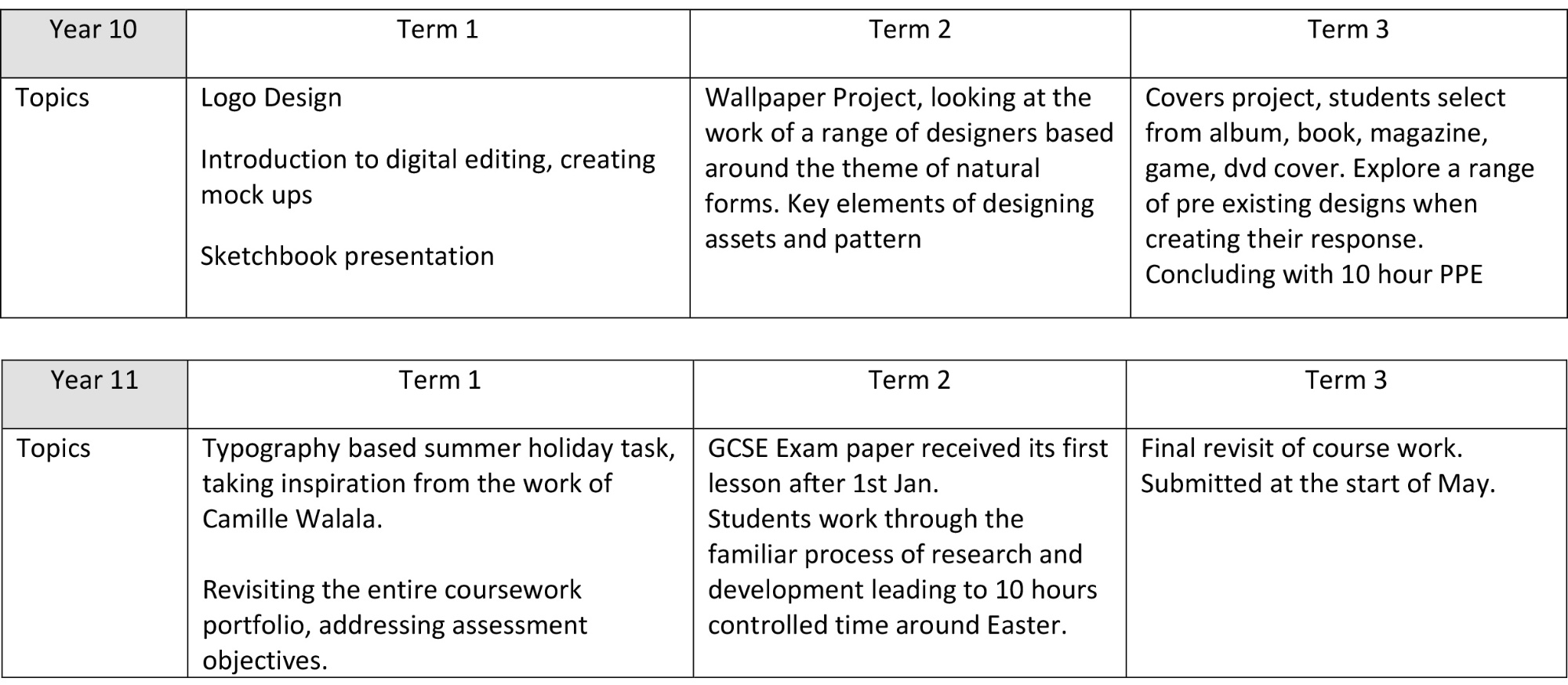
Assessment Criteria
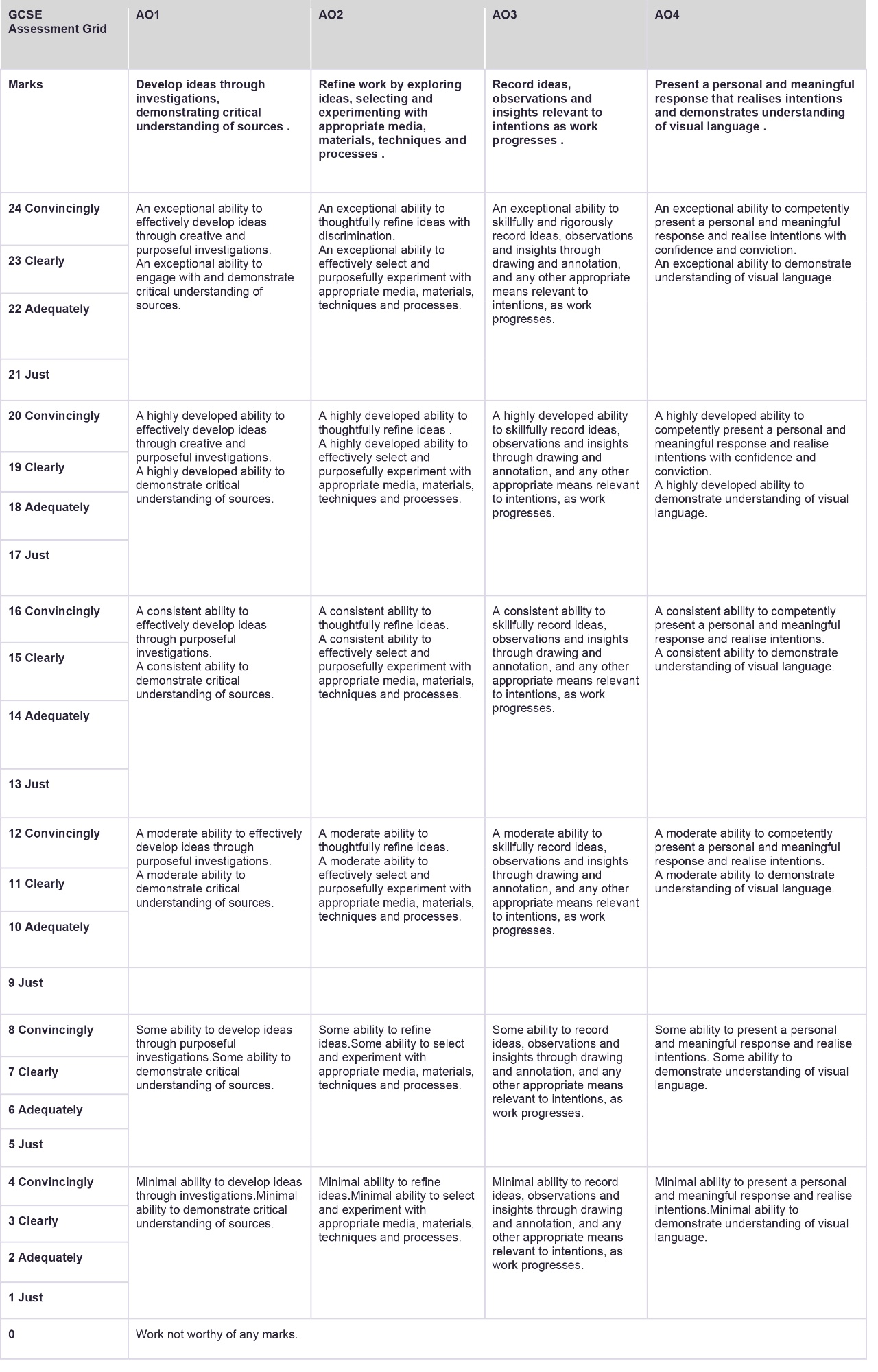
The assessment criteria must be applied to the assessment of students’ work for both components. The assessment objectives are equally weighted in each case. The Assessment criteria grid indicates the levels of attainment that would be expected for the award of marks in the ranges shown.
Each component is marked out of a total of 96 marks. As the assessment objectives are equally weighted in each component, there is a maximum of 24 marks for each of the assessment objectives.
The marks, out of 24, for each assessment objective must be added together to produce the total mark out of 96.
You are required to provide a mark for each of the assessment objectives separately in accordance with the assessment criteria and a mark out of 96 must be provided for each component. The assessment grid must be used to identify the student’s level of performance in relation to each of the assessment objectives.
Six mark band descriptors are provided, with a range of marks for each of the four assessment objectives.
A Candidate record form (CRF) must be completed for each student for each component. When completing each form the teacher should decide which mark band best describes the student’s performance for each assessment objective, then circle the appropriate mark. These marks should then be transferred to the ‘mark awarded’ row and added together. This total should be entered in the ‘total mark box’ to the right of the grid.
Four marks are available for each mark band in each assessment objective. The lower mark indicates that the student has just met the requirement described in that particular band, the next mark indicates that evidence is adequate , the next that evidence is clear and the higher mark indicates that evidence is convincing but that the student has not quite met the requirements set out in the next band.
Assessing Components 1 and 2
For Component 1, the portfolio submission must be assessed as a whole, using the assessment grid to select which of the six mark band descriptors for each objective best describes the student’s overall performance. The same process is met for Component 2, preparatory studies and the work undertaken in the supervised time, must be assessed together when arriving at an overall mark.
Supervising and Authenticating
To meet Ofqual’s qualification and subject criteria:
students must sign the Candidate record form (CRF) to confirm that the work submitted is their own
all teachers who have marked a student’s work must sign the declaration of authentication on the CRF. This is to confirm that the work is solely that of the student concerned and was conducted under the conditions laid down by this specification
Teachers must ensure that a CRF is provided with each student’s work.
Students must have sufficient direct supervision to ensure that the work submitted can be confidently authenticated as their own.
Any work produced without supervision, for example outside of the classroom, should be compared to work produced with supervision.
In comparing the student's work, consideration must be given to the consistency in levels of skill demonstrated as well as the application and understanding of the techniques, processes and
materials employed.
Work that cannot be confidently authenticated must not be included in the student’s submission.
If a student receives additional assistance and this is acceptable within the guidelines for this specification, you should award a mark that represents the student’s unaided achievement. Please note the support the student received on the CRF and sign the authentication statement. If the statement is not signed, we cannot accept the student’s work for assessment.
Avoiding Malpractice
Please inform your students of the AQA regulations concerning malpractice. They must not:
submit work that is not their own
lend work to other students
allow other students access to, or use of, their own independently-sourced source material
include work copied directly from books, the internet or other sources without acknowledgement
submit work that is word-processed by a third person without acknowledgement
include inappropriate, offensive or obscene material.
These actions constitute malpractice and a penalty will be given (for example, disqualification).
Consult the exams officer about these procedures.
You must ensure that you have consistent marking standards for all students. Subject leader must manage this process and they must sign the Centre declaration sheet to confirm that internal standardisation has taken place.
Internal standardisation may involve:
all teachers marking some sample pieces of work to identify differences in marking standards
discussing any differences in marking at a training meeting for all teachers involved
referring to reference and archive material, such as previous work or examples from our teacher standardisation.
Keeping Students' Work
Students’ work must be kept under secure conditions from the time that it is marked, with completed CRF. After the moderation period and the deadline for Enquiries about Results (or once any enquiry is resolved) you may return the work to students.
Moderation
An AQA visiting moderator will check a sample of your students’ work. They will make contact to let you know which students’ work will be required in the sample to be provided for moderation.
The moderator reviews your marking to check whether any changes are needed to bring the marking in line with the agreed standards. In some cases the moderator will ask to see more work. Any changes to marks will normally keep your rank order but, where major inconsistencies are found, AQA reserves the right to change the rank order.
You will receive a report when the results are issued, which will give feedback on the appropriateness of the tasks set, interpretation of the marking criteria and how students performed in general.
Key Stage 5
Subject Intent
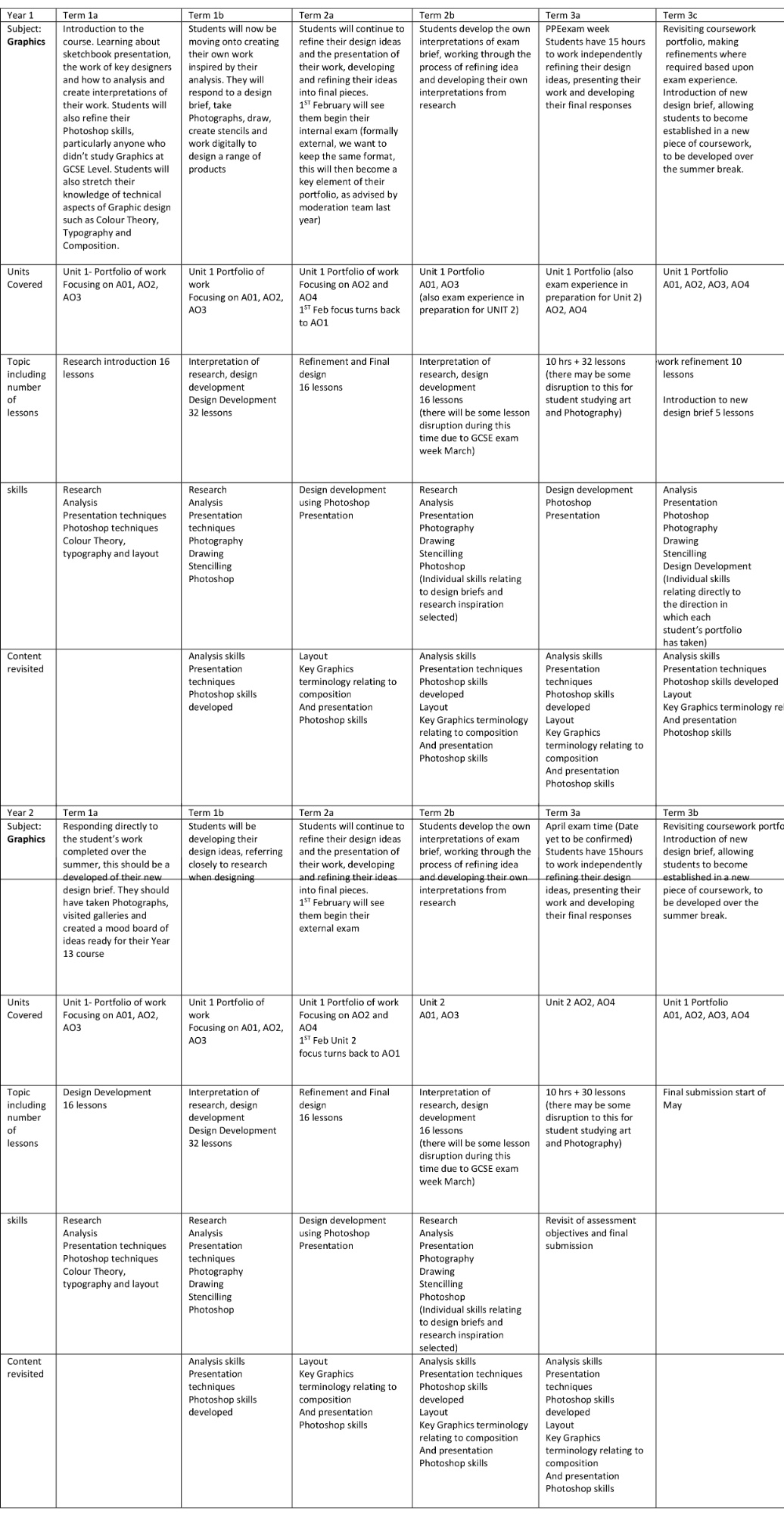
Studying Graphic Design at A Level opens up a wide range of opportunities, both in further education and in creative industries. Here are the main routes and possibilities:
Graphic Designer - Creating visual content for print and digital media, such as branding, advertising, and marketing materials.
Illustrator - Producing drawings or digital illustrations for books, magazines, games, or online platforms.
Animator / Motion Graphics Designer - Designing animated sequences for film, TV, advertising, or social media.
Web Designer / UI Designer - Building and styling websites or app interfaces with a focus on visual appeal and user experience.
Advertising / Marketing Designer - Developing visual campaigns for brands, including posters, social media graphics, and digital ads.
Photographer / Photo Editor - Working with images for editorial, commercial, or artistic purposes, often integrating design skills.
Art Director - Overseeing visual styles and creative direction for magazines, campaigns, films, or design studios.
Packaging Designer - Designing labels, boxes, and packaging that communicate brand identity and appeal to consumers.
Typographer - Specialising in font design and the creative use of type in visual communication.
Digital Content Creator / Visual Communicator - Combining graphic design, video, and social media to produce engaging digital content.
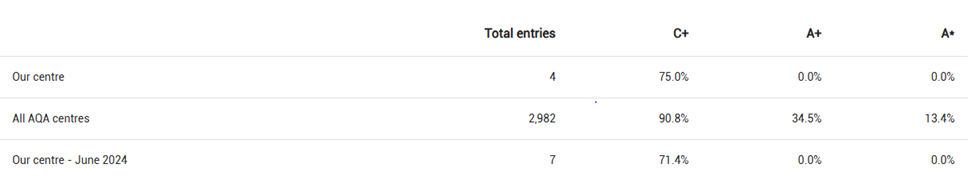
GCSE Graphics Attainment 2024

A Level Graphics Attainment 2024
Former Student Destinations
Hamzaa Valli (now co owner of Advantage-Media)
Left Thornleigh to study Graphic Design at University of Bolton in 2019. Now runs a marketing agency in Bolton with his wife, who also studied at Bolton Uni. Together they work with various clients designing for social media campaigns and marketing.
Charlotte Halliwell
Completing a Level 3 content Creation apprenticeship with the brand Rose and Caramel. Been based at the brand for 6 months. Began her journey through ‘NowSkills’ which introduced her to a selection of possible apprenticeship options.
Eilish Anderson
Left Thornleigh and studied a fashion promotion course at UCLAN. Has worked for companies such as TOPMAN, Boohooman and JD Sports. Eilish now specialises in influencer and talent marketing on social channels.
Callum Smyth
Left Thornleigh to study Graphic Design at Manchester Met Uni. After the completion of his course he has worked for various promotional merchandising companies before securing a post at Manchester Met in their marketing department. Callum leads on digital design and advertising for the university.
Ryan Jeffers
Ryan studied Graphic Communication at Northampton University and moved to London. Ryan has worked for several Graphic Design agencies over 8 years prior to deciding on a career change. Ryan is currently completing his ECT training to become a teacher at Turton High School.