









Computer Science
Subject Introduction
The Computer Science curriculum at Thornleigh Salesian College is designed to equip students with the knowledge and skills they need to become confident digital citizens in an increasingly technological world. By engaging with computational thinking and problem solving, students learn how to analyse, model, and create solutions to real world problems. These skills develop logical reasoning, creativity, and resilience, all essential qualities for future citizens who will live and work in a society shaped by technology. The curriculum not only prepares students for careers in computing but also empowers them to use technology thoughtfully, responsibly, and ethically in everyday life.
At Key Stage 3 (KS3), the curriculum closely follows the aims of the national curriculum for computing, ensuring students develop a strong foundation in programming, algorithms, and data representation. They explore how computer systems work, understand the role of binary and logic, and begin to design modular programs using multiple programming languages. Alongside this, they engage in creative digital projects that build confidence in using a range of software and applications. This stage is essential for nurturing curiosity and establishing the core principles that underpin both computer science and information technology.
These KS3 experiences provide a stepping stone to Key Stage 4 / 5, where students apply their foundational understanding to more complex and independent computational challenges. The focus shifts from learning fundamental concepts to mastering their application, developing more sophisticated programs, analysing algorithms, and understanding the broader impact of technology on society. By progressing through a coherent, well-sequenced curriculum, students are prepared not only for GCSE / A-Level Computer Science but also to be responsible, informed, and adaptable users of technology in their future studies, careers, and daily lives.
Aims
The national curriculum for computing aims to ensure that all students:
- Think computationally, modelling and solving real-world problems using algorithms and logical reasoning.
- Enable students to program confidently in two different programming languages, block based and written
- Teach students how computers work, including hardware, software, and how data and instructions are stored and processed.
- Develop understanding of binary and Boolean logic and how they’re used in computing and digital systems.
- Encourage students to use technology creatively, combining applications to design, make, and improve digital projects.
- Ensure students use technology safely, responsibly, and respectfully, protecting their privacy and recognising inappropriate online behaviour.
Key Stage 3
Curriculum Intent
At Key Stage 3, the computing curriculum at Thornleigh closely aligns with the national curriculum, ensuring students build a strong foundation in programming, algorithms, computer systems, and data representation. Students explore how computer systems operate, develop an understanding of binary and logic, and begin designing modular programs using multiple programming languages. Alongside this, they engage in creative digital projects that build confidence in using a wide range of software and applications.
The curriculum explicitly identifies, sequences, and connects both declarative knowledge ('knowing that') and procedural knowledge ('knowing how'), supporting meaningful learning. Competence in using technology is built on this solid foundation, ensuring that students are confident, capable, and well-prepared for further study or careers in computing and digital technologies.
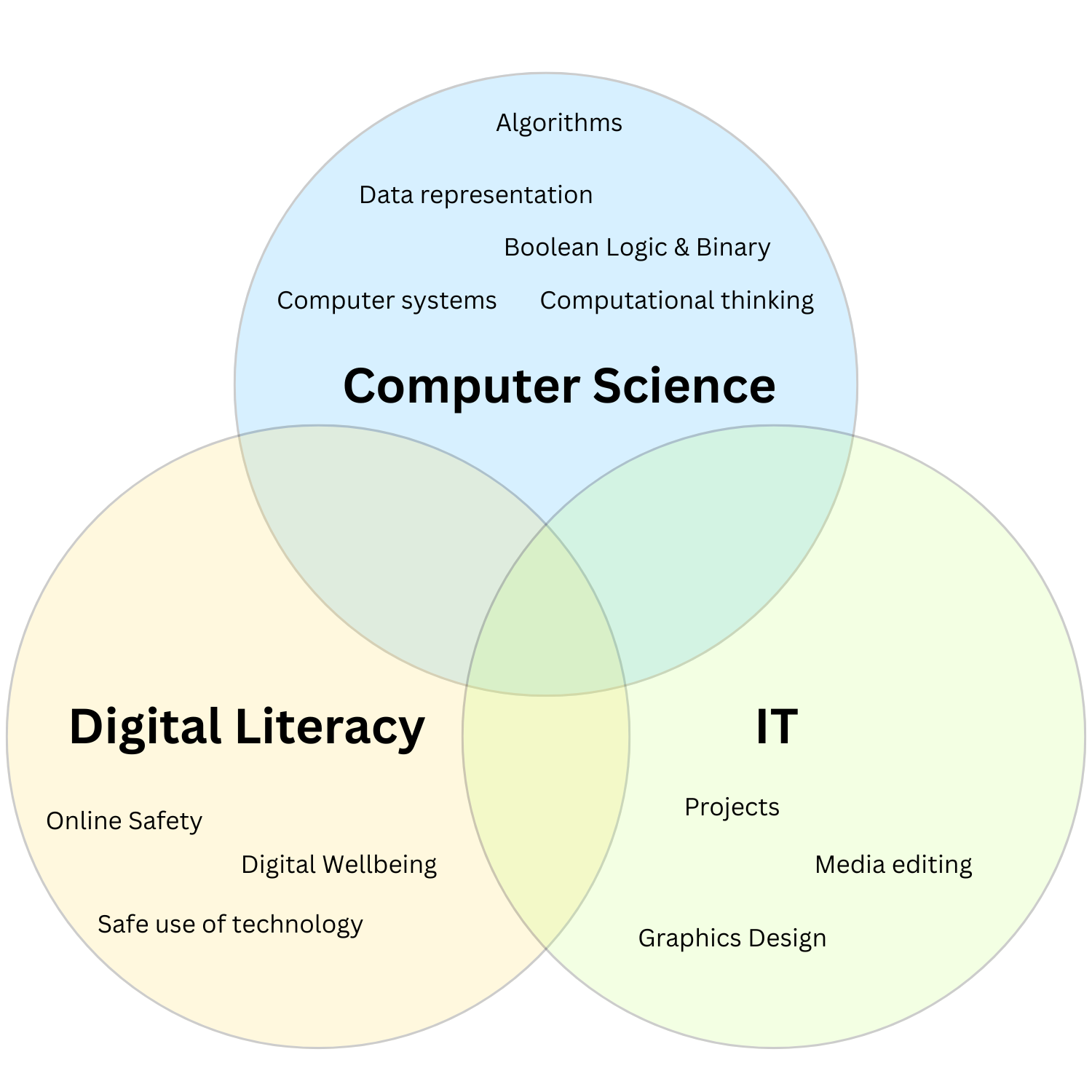
The curriculum is structured around three main areas: Information Technology, Computer Science, and Digital Literacy, all of which are covered thoroughly at Thornleigh. By the time students leave, they will have gained experience in:
- Information Technology: word processing, presentations, and data handling
- Computer Science: Programming, and understanding computer networks
- Digital Literacy: using technology safely and critically analysing digital content
This approach ensures that students not only develop technical skills but also the knowledge and confidence to apply them creatively and safely in a digital world.
National Curriculum
Computer Science (CS)
- design, use and evaluate computational abstractions that model the state and behaviour of real-world problems and physical systems
- understand several key algorithms that reflect computational thinking [for example, ones for sorting and searching]; use logical reasoning to compare the utility of alternative algorithms for the same problem
- use two or more programming languages, at least one of which is textual, to solve a variety of computational problems; make appropriate use of data structures [for example, lists, tables or arrays]; design and develop modular programs that use procedures or functions
- understand simple Boolean logic [for example, AND, OR and NOT] and some of its uses in circuits and programming; understand how numbers can be represented in binary, and be able to carry out simple operations on binary numbers [for example, binary addition, and conversion between binary and decimal]
- understand the hardware and software components that make up computer systems, and how they communicate with one another and with other systems
- understand how instructions are stored and executed within a computer system; understand how data of various types (including text, sounds and pictures) can be represented and manipulated digitally, in the form of binary digits
Information Technology (IT)
- undertake creative projects that involve selecting, using, and combining multiple applications, preferably across a range of devices, to achieve challenging goals, including collecting and analysing data and meeting the needs of known users
- create, re-use, revise and re-purpose digital artefacts for a given audience, with attention to trustworthiness, design and usability
Digital Literacy (DL)
- understand a range of ways to use technology safely, respectfully, responsibly and securely, including protecting their online identity and privacy; recognise inappropriate content, contact and conduct and know how to report concerns.
Mapping
A broad and balanced Computing curriculum has been designed to provide students with learning opportunities in Computer Science, IT and Digital Literacy
KS3 Curriculum Overview
Year 7
Introduction to Computing
- Learn how to access the school network, email, ClassCharts, and Google applications, and navigate them with ease
- Understand how to create strong, secure passwords using a range of effective techniques
- Know how to stay safe while using computers and online services, following best practices for security and privacy
- Learn about the different forms cyberbullying can take online, how to identify the warning signs, ways to stop it effectively, and who to report it to for help and support.
- Gain insight into how cybercriminals operate, what their goals are, and practical steps you can take to protect yourself and prevent these crimes from happening.
Flowcharts + Logo
- Learn how algorithms are designed and discover the key steps involved in converting an algorithm from a written plan into a functioning computer program.
- Understand how to represent an algorithm using a flowchart, applying the correct symbols to show each step clearly and accurately.
Block Based Programming - Scratch
Introduction to Python
AI
Year 8
- Cyber security
- Graphic design
- Computer systems
- Data representation
- Further Python programming
Year 9
- Digital wellbeing
- Games design
- Programming using robots
- Advanced python programming
- AI and Machine learning
Key Stage 4
Curriculum Intent
All pupils must have the opportunity to study aspects of information technology and computer science at sufficient depth to allow them to progress to higher levels of study or to a professional career.
All pupils will be taught to:
- Develop their capability, creativity and knowledge in computer science, digital media and information technology
- Develop and apply their analytic, problem-solving, design, and computational thinking skills
- Understand how changes in technology affect safety, including new ways to protect their online privacy and identity, and how to identify and report a range of concerns.
Key Stage 5
Curriculum Intent
GCE AS and A level Subject Content for Computer Science Introduction
AS and A level subject content sets out the knowledge, understanding and skills common to all AS and A level specifications in computer science.
Aims and objectives
All specifications in computer science must build on the knowledge, understanding and skills established at key stage 4 and encourage students to develop a broad range of the knowledge, understanding and skills of computing, as a basis for progression into further learning and/or employment.
AS and A level specifications in computer science must encourage students to develop:
An understanding of, and the ability to apply, the fundamental principles and concepts of computer science, including abstraction, decomposition, logic, algorithms and data representation the ability to analyse problems in computational terms through practical experience of solving such problems, including writing programs to do so the capacity for thinking creatively, innovatively, analytically, logically and critically the capacity to see relationships between different aspects of computer science mathematical skills (as set out in the attached annex) the ability to articulate the individual (moral), social (ethical), legal and cultural opportunities and risks of digital technology Subject content Knowledge and understanding
AS and A level specifications must require students to develop a knowledge and understanding of the fundamentals of computer science and programming including: fundamentals of programming the concept of data type, including primitive data types and complex data structures data representation 2 following and writing algorithms methods of capturing, selecting, exchanging and managing data to produce information for a particular purpose the need for and functions of systems software characteristics of contemporary systems architectures, including processors, storage, input, output and their connectivity characteristics of networks and the importance of networking protocols and standards the individual (moral), social (ethical), legal and cultural opportunities and risks of digital technology 5.
In addition, A level specifications must require students to develop a knowledge and understanding of: the importance of the efficiency of an algorithm; that this can be measured in terms of execution time and space requirements, and that the efficiency of algorithms that perform the same task can be compared standard algorithms the use of databases to store, retrieve and manipulate data, including database programming and producing a data model the need for and characteristics of a variety of programming paradigms Skills 6.
AS and A level specifications must require students to develop the following skills: take a systematic approach to problem-solving design, write and test programs to either a specification or to solve a problem articulate how a program works, arguing for its correctness and efficiency using logical reasoning, test data, and user feedback use abstraction effectively: to appropriately structure programs into modular parts with clear, well documented interfaces to model selected aspects of the external world in a program apply computing-related mathematics 7
In addition, A level specifications must require students to: know and understand how to write specifications for a programming solution 3 Annex: mathematical skills Computer science uses mathematics to express its computational laws and processes. Any accredited specification in computer science must contain a minimum of 10% mathematics. Awarding organisations are free to include and assess a greater percentage of mathematics.
Students may be asked to demonstrate their knowledge and understanding and skills of computational processes and problem-solving in both theoretical and practical ways. The following list shows the key topics that will be common to all specifications in computer science. For each topic below, while the concepts are Level 2 (though not all appear in GCSE mathematics specifications), students will, however, be expected to apply the skills they acquire in a Level 3 context.
Topics: Boolean algebra Comparison of complexity of algorithms* Number representations and bases *applicable to A level only due to its advanced nature.
How the Curriculum is taught at Thornleigh Salesian College
Lead with Concepts
Introduce key computing concepts, terms, and vocabulary explicitly, but connect them to real-world applications and higher-level thinking. Encourage students to create their own glossaries, concept maps, or visual summaries, and use frequent recall exercises to reinforce understanding. At this level, encourage students to explain concepts to each other in their own words, fostering deeper cognitive engagement.
Work Together
Promote collaboration through structured pair programming, peer instruction, and small group problem-solving tasks. Encourage students to debate and justify their coding choices, algorithms, or design decisions. Incorporate collaborative online tools (GitHub Classroom, Google Colab) to mirror real-world computing environments. Focus on developing not just understanding, but communication and teamwork skills.
Get Hands-on
Use physical computing and making projects that integrate programming, electronics, and creative design (e.g., robotics, Arduino, Raspberry Pi, IoT projects). Challenge students with projects that require them to combine coding and design thinking, and encourage exploration through open-ended tasks that allow creativity and experimentation.
Model Everything
Use live coding, worked examples, and think-aloud demonstrations for complex tasks such as debugging, algorithm tracing, or database queries. Show multiple solution strategies and highlight trade-offs. Encourage students to model their own solutions publicly, sharing thought processes and reasoning with peers.
Foster Programme Comprehension
Design regular activities that strengthen understanding of programme structure and behaviour, such as tracing, debugging, code review, and Parson’s Problems. Encourage students to predict outcomes, explain code behaviour, and reflect on logic and efficiency. Integrate discussions on code readability, maintainability, and best practice.
Create Projects
Use project-based learning to challenge students to apply knowledge creatively and solve authentic problems. Include considerations of design, user experience, and functionality. Encourage iterative development, testing, and reflection, simulating real-world software development processes.
Add Variety
Offer a balance of structured exercises, semi-structured challenges, and open-ended exploration. Scaffold tasks according to skill level and gradually reduce support, promoting independence. Include mini-competitions or hackathons to make exploratory tasks motivating and engaging.
Challenge Misconceptions
Use formative assessments, quizzes, and peer discussion to reveal misconceptions (e.g., off-by-one errors, misunderstanding loops, or data structures). Encourage students to debug and correct errors collaboratively, reflecting on their reasoning process to strengthen conceptual understanding.
Make Concrete
Use contextualised examples, case studies, or simulations to show abstract computing concepts in real-world settings (e.g., encryption in messaging apps, algorithms in social media feeds). Connect concepts to other subjects like maths, physics, or economics to reinforce relevance and interdependence.
Structure Lessons
Use lesson frameworks like PRIMM (Predict, Run, Investigate, Modify, Make) or Use-Modify-Create to structure programming lessons while allowing differentiation. Integrate reflection and metacognition into lessons, encouraging students to plan, evaluate, and refine their solutions.
Computer Science Department Homework Policy
Homework in the Computer Science Department is set to reinforce classroom learning, support student progress, and develop effective independent study skills. All homework is carefully planned, purposeful, and directly linked to the curriculum being taught in lessons. Tasks are designed to be manageable in length and difficulty, ensuring that students can complete them successfully alongside their commitments in other subjects.
Homework may include practice tasks, programming exercises, revision activities, or short research assignments, all of which are intended to strengthen understanding of key concepts and skills. Regular homework supports continuity of learning between lessons and helps students to build confidence, responsibility, and independence in their approach to Computer Science.
Aims of Homework
The main aim of homework is to consolidate knowledge and skills introduced in class. Homework provides opportunities for students to practise computational thinking, develop programming skills, and apply theoretical knowledge in a structured and supportive way.
Homework also supports long-term retention by encouraging regular review and reinforcement of learning. In addition, it helps prepare students for assessments and examinations by developing familiarity with exam-style questions, extended problem-solving tasks, and independent revision, particularly at Key Stage 4 and Key Stage 5.
Key aims include:
- Reinforce and consolidate classroom learning
- Develop computational thinking and programming skills
- Encourage independent study and problem-solving
- Support long-term retention and exam preparation
- Build confidence in applying concepts independently
Homework Expectations by Key Stage
Key Stage 3
At KS3, homework is set every two weeks and is designed to build foundational knowledge and engagement with Computer Science. Tasks are short, focused, and accessible.
- Frequency: Once every two weeks
- Expected time: Approximately 30 minutes
- Tasks may include Seneca Learning, exam-style questions, practical programming tasks, independent learning, project work and revision activities
- Homework is linked to the current or most recently taught unit of work
Key Stage 4 and Key Stage 5
At KS4 and KS5, homework is set weekly to deepen understanding and support exam preparation. Tasks may also include retrieval practice from prior learning.
- Frequency: Weekly
- Expected time: Approximately 60 minutes
- Tasks may include Seneca Learning, exam-style questions, practical programming tasks, independent learning, project work and revision activities
- Homework is focused on the current topic being studied
Roles and Responsibilities
Teachers are responsible for setting appropriate homework in line with this policy, ensuring tasks are clearly explained and accessible, and monitoring completion. Feedback will be provided where appropriate to support progress. Homework will be issued by teachers during the lesson and recorded on classcharts and other appropriate places depending on the homework set.
Students are expected to complete homework to the best of their ability and submit it by the deadline. Students should seek support if they do not understand the task.
Parents and carers are encouraged to use ClassCharts to support and monitor homework completion.
Monitoring and Inclusion
Homework completion and quality are monitored by class teachers and used to inform teaching and support. Homework will be set with consideration for SEND and individual needs, with reasonable adjustments made where required.