








English
Subject Introduction
Our English curriculum is designed to provide education for all, fulfilling the aims of the National Curriculum by ensuring that every student, regardless of background, achieves mastery in reading, writing, and spoken language. It builds on the skills established in KS2, strengthening literacy while broadening horizons through ambitious texts and tasks. Sequenced carefully from KS3 to KS5, it prepares students for the demands of GCSE and A-Level, embedding knowledge and skills that enable academic success and lifelong learning.
We believe that studying Literature opens doors to other lives, cultures and experiences, helping students to see the world through different eyes. Our students explore a rich range of texts from the last four centuries - from Shakespeare and Dickens to Orwell and beyond - connecting with the voices of today while understanding the struggles, ideas and imaginations of the past. Through these stories, they learn empathy, curiosity and the confidence to form and express their own opinions. Literature becomes a bridge across time, reminding students that the questions and challenges of history still shape the world around them. Language, in turn, gives them the tools to think critically, argue clearly and communicate with impact. At Thornleigh, English helps young people make sense of the world, shaping how they read, write and speak, and empowering them to use their voice with purpose and confidence.
Through English, our students grow not only as learners but as thoughtful, articulate individuals ready to contribute to the world beyond school. They gain the cultural knowledge to engage with society, the empathy to understand others, and the confidence to make their own voices heard. This journey continues into our Sixth Form, where students can specialise further in English Language or Literature, deepening their expertise and preparing for university, training, or future careers that value clear thinking and effective communication.
Key Stage 3
Curriculum Intent
Reading is at the heart of our curriculum
Every unit at Key Stage 3 is built around sustained, challenging reading, and every English lesson follows the same structured reading routine so that students approach each new text with the same clear, consistent support.
Our reading strategy
1. Pre-Reading - Before reading, students are given the key vocabulary needed to access the text, including word origins, and are told the purpose of the reading.
2. Ready to Read - Students prepare to read with a copy of the text in front of them, focused and ready to follow along.
3. During Reading - The teacher models fluent reading aloud. Students then read using one of several supported approaches - reading together as a class, in pairs, or echoing sentences back — and understanding is checked through discussion and questioning throughout.
4. Post-Reading - Students move into guided practice, building on what they have read, understood and discussed.
This routine is used consistently across all three years of Key Stage 3, whatever text students are reading.
Curriculum Overview
Across Years 7 to 9, students study a full-length novel and a complete Shakespeare play every year, alongside poetry, speeches, essays and journalism. Five ideas — narrative, rhetoric, genre, influence and metaphor — are returned to across all three years, each time through more demanding texts, so students build on what they have already learned rather than meeting each idea only once.
Writing is taught through a staged process that develops from sentence-level control in Year 7 to sustained, whole-text argument by Year 9. Students also take part in a Key Stage 3-wide reading programme, in which they read and respond to a piece of world literature roughly every three weeks throughout the three years, alongside the texts studied in lessons.
Year 7
|
Term |
Focus |
What students study |
|
Autumn |
Foundations of Story |
Darkside, read as a fast-paced introduction to the key stage, followed by a study of poetry from around the world and a scheme exploring heroes and villains in fiction |
|
Spring |
Crafting Viewpoint and Voice |
Persuasive speeches by contemporary public figures, studied for rhetoric and structure, and how to establish and maintain a clear viewpoint in non-fiction writing |
|
Summer |
Exploring Meaning through Story |
A contemporary novel and Shakespeare's The Tempest, alongside poetry exploring protest and social themes |
Students begin building their understanding of symbolism, character and structure, and meet their first Shakespeare play of the key stage.
Year 8
|
Term |
Focus |
What students study |
|
Autumn |
The Gothic Tradition |
A contemporary Gothic novel alongside extracts from 19th-century Gothic writing |
|
Spring |
The Art of Rhetoric |
A political allegory novel, studied alongside its historical context |
|
Summer |
The Construction of Tragedy |
Shakespeare's Romeo and Juliet and a modern stage play, studied together, alongside a study of sonnet form |
Students extend their understanding of genre and historical context, and compare how tragedy is constructed across different forms and time periods.
Year 9
|
Term |
Focus |
What students study |
|
Autumn |
Dystopian Fiction |
A contemporary dystopian novel, alongside extracts from the wider dystopian tradition |
|
Spring |
Moral Complexity |
A modern tragedy and a verse novel, studied for character, form and moral ambiguity |
|
Summer |
Shakespeare and Rhetoric |
Shakespeare's Julius Caesar, studied alongside political speeches and protest poetry |
Year 9 is designed to be the most demanding year of Key Stage 3, building directly toward the reading and writing skills required at GCSE.
Supporting all students
Every student is taught the same ambitious curriculum; texts and tasks are not simplified for any group. Where individual students need additional support — for example through adapted resources or additional adult support — this is provided in line with the school's SEND policy and reviewed regularly, so that support builds toward independence over time.
Finding out more
Full details of the units, texts and assessment covered in each year group are available from the English department. Parents and carers who would like more information about the Key Stage 3 English curriculum can contact the school office, who will direct enquiries to the Head of English.
Key Stage 4
Curriculum Intent
Building on Key Stage 3, preparing for GCSE success
Key Stage 4 English continues the same ambitious approach to reading and writing that students have built across Key Stage 3, while steadily shifting focus towards the demands of the GCSE English Language and English Literature examinations. In Year 10, our priority is GCSE Literature: this keeps the enjoyment of English at the heart of the curriculum for as long as possible and reflects the approach taken at Key Stage 3, while exam-focused drilling is reserved for Year 11. This does not mean Language is set aside — the analytical and evaluative skills the Language exams require are built continuously through our study and discussion of Literature texts. In Year 11, students move through a structured cycle of Language and Literature study, building towards a sustained period of revision and exam practice.
Our Approach
1. Robust, challenging reading — Students read whole texts in full rather than relying on extracts or summaries. The vocabulary and context needed to access each text is taught explicitly before and during reading, so that the challenge students face is the ideas and language of the text itself.
2. Explicit teaching of knowledge and skill — Both the content knowledge students need — plot, character, context — and the exam skills they must apply — analysing structure and language, evaluating writers' methods, constructing an argument — are taught directly and revisited regularly across the two years, so that students build genuine control of both.
3. Discussion and modelling — Teachers model analytical thinking and writing, showing students what a strong response looks like and how to arrive at one. Structured classroom discussion routines give students the chance to test, articulate and refine their own interpretations out loud before they commit them to writing.
4. Independent retrieval practice with Carousel Learning — Students use the Carousel Learning platform — particularly during Year 11 revision — to build a regular habit of low-stakes quizzing, spaced retrieval and self-marking, developing the independence to identify and close their own gaps in knowledge.
Our team of experienced English teachers bring a genuine breadth of interests and backgrounds to their teaching, and share a real passion and enthusiasm for the subject that inspires students of all abilities. We want students to take this mentality on board too: GCSE English is a marathon, not a sprint, and progress is built steadily and securely over the two years. Assessments along the way are there to guide that journey — each one is a signal of what to work on next, not a final verdict.
Curriculum Overview
Year 10
|
Term |
Focus |
What students study |
|
Autumn 1 |
Voices of Authority |
An Inspector Calls, alongside the poem “Exposure”; persuasive writing for Language Paper 2 |
|
Autumn 2 |
The Power of Change |
A Christmas Carol, alongside the poem “London”; descriptive and narrative writing for Language Paper 1 |
|
Spring 1 |
Power, Pride and Prophecy (i) |
A Christmas Carol (continued) and the start of Macbeth, alongside the poem “Ozymandias”; speech writing for Language Paper 2 |
|
Spring 2 |
Power, Pride and Prophecy (ii) |
Macbeth, alongside the poem “My Last Duchess”; speech writing for Language Paper 2 |
|
Summer 1 |
Battle Scars |
Macbeth (continued) and the conflict poetry cluster, including “Kamikaze”, “Remains”, “The Charge of the Light Brigade”, “Bayonet Charge”, “Poppies” and “War Photographer”; spoken language study |
|
Summer 2 |
The Stories We Carry |
The power and conflict poetry cluster, including “The Emigree”, “Tissue”, “Checking Out Me History”, “Storm on the Island” and “The Prelude”; spoken language study |
Year 11
|
Term |
Focus |
What students study |
|
Autumn 1 |
Cycled Revision |
A structured revision cycle covering all Literature texts studied in Year 10, alongside Language Paper 2 reading and writing |
|
Autumn 2 |
Poetry |
The poetry anthology, alongside Language Paper 1 reading and writing |
|
Spring 1 |
Prose Revision |
A Christmas Carol and Macbeth revision, alongside Language Paper 1 |
|
Spring 2 |
Drama and Poetry Revision |
An Inspector Calls and poetry revision, alongside Language Paper 2 |
|
Summer 1 |
Revision and Drilling |
Sustained, exam-focused revision and practice across both Language and Literature |
|
Summer 2 |
Revision and Drilling |
Sustained, exam-focused revision and practice across both Language and Literature |
Supporting all students
Every student is taught the same ambitious GCSE curriculum; texts and tasks are not simplified for any group. Where individual students need additional support — for example through adapted resources or additional adult support — this is provided in line with the school's SEND policy and reviewed regularly, so that support builds towards independence over time.
Finding out more
Full details of the units, texts and assessment covered in each year group are available from the English department. Parents and carers who would like more information about the Key Stage 4 English curriculum can contact the school office, who will direct enquiries to the Head of English. For questions about an individual student's progress, their class teacher is always the first point of contact.
Key Stage 5
English Literature
English Language
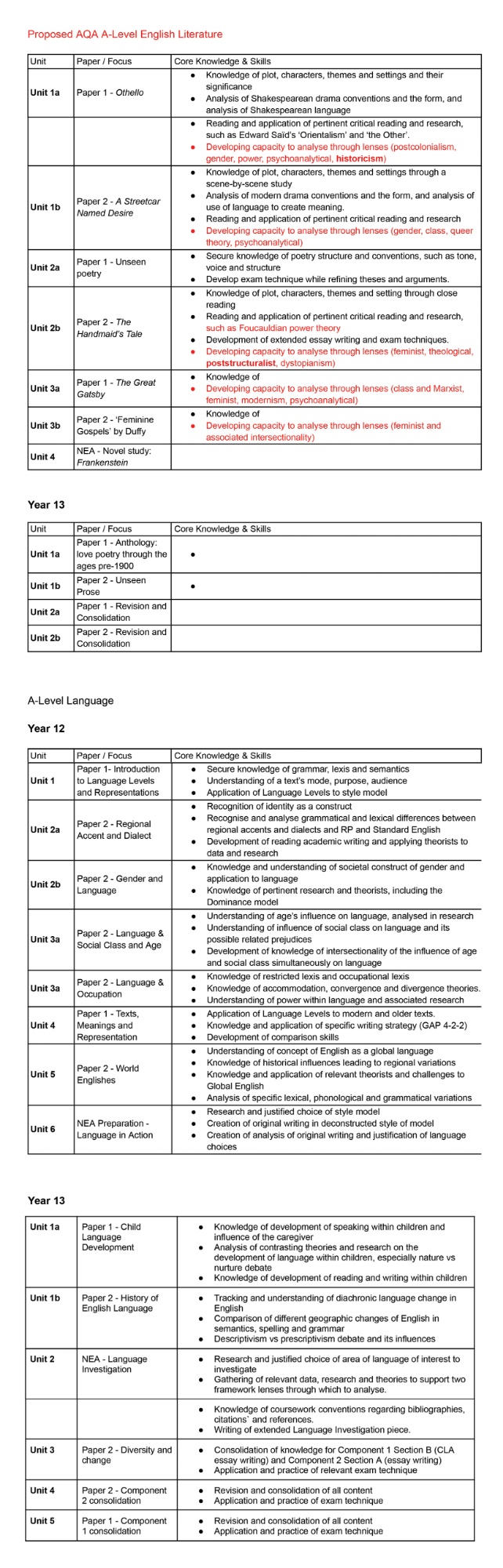
Year 12
|
Unit |
Paper / Focus |
Core Knowledge & Skills |
|
Unit 1 |
Paper 1- Introduction to Language Levels and Representations |
|
|
Unit 2a |
Paper 2 - Regional Accent and Dialect |
|
|
Unit 2b |
Paper 2 - Gender and Language |
|
|
Unit 3a |
Paper 2 - Language & Social Class and Age |
|
|
Unit 3a |
Paper 2 - Language & Occupation |
|
|
Unit 4 |
Paper 1 - Texts, Meanings and Representation |
|
|
Unit 5 |
Paper 2 - World Englishes |
|
|
Unit 6 |
NEA Preparation - Language in Action |
|
Year 13
|
Unit 1a |
Paper 1 - Child Language Development |
|
|
Unit 1b |
Paper 2 - History of English Language |
|
|
Unit 2 |
NEA - Language Investigation |
|
|
Unit 3 |
Paper 2 - Diversity and change |
|
|
Unit 4 |
Paper 2 - Component 2 consolidation |
|
|
Unit 5 |
Paper 1 - Component 1 consolidation |
|